Share

Stories have a tendency to change when a lot of folks are sharing them. It’s a big game of telephone, and phrases may shift the further you get from the source. Hoosier Energy Member Relations Specialists Kyle Coulson and Justin Thompson share why the G&T created their roles to help streamline and strengthen consistent storytelling in Indiana and Illinois.
Recorded LIVE at StoryConnect 2023. This episode is sponsored by Meridian Cooperative.
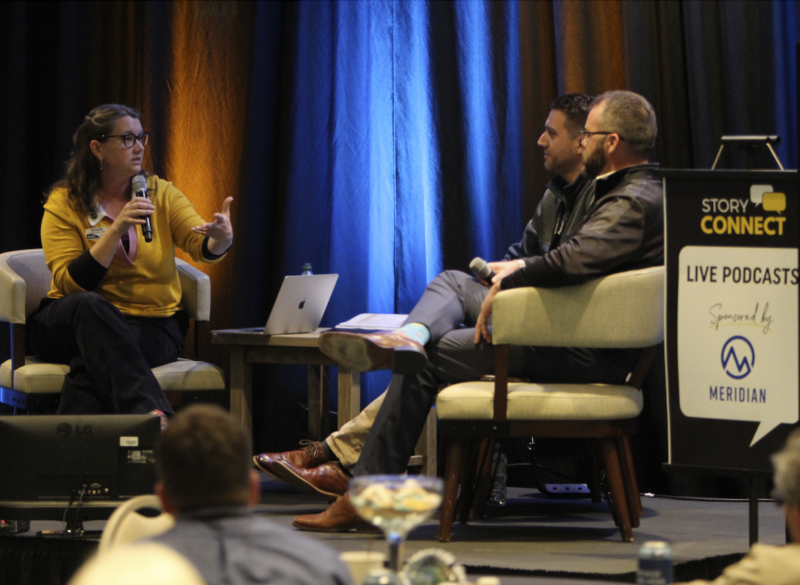
Kyle Coulson and Justin Thompson
Transcripts have been lightly edited for clarity and readability.
Intro: A production of Pioneer Utility Resources. StoryConnect, helping communicators discover ideas to shape their stories and connect with their customers.
Megan McKoy-Noe: How can member focused roles on your team strengthen your story? That’s what we’ll be talking about on this episode of The StoryConnect Podcast. Hi, I’m your host, Megan McKoy-Noe, at Pioneer Utility Resources. I’m excited to be with you today. And I am joined by member relations specialists Kyle Coulson and Justin Thompson from Hoosier Energy. Kyle and Justin, thank you so much for joining us. But we are not alone here. We are recording in front of an amazing group of utility pioneers at StoryConnect. I think utility pioneers deserve a round of applause every day, but it is so nice to have you all with us now. And this episode of The StoryConnect Podcast is sponsored by our co-op friends at Meridian Cooperative who use powerful innovations to empower utilities. Let’s thank them for supporting utility storytellers. All right, let’s get this party started. Now, Hoosier Energy is a generation and transmission co-op partnering with 18 utilities to serve more than 760,000 consumers in both Indiana and Illinois. That’s not a lot of folks to reach with stories. And so y’all decided to try something different. Kyle, last year, you and Justin got new job titles. Huzzah! Can you tell me why Hoosier created your member-focused roles?
Kyle Coulson: Absolutely. So last year, Hoosier realized that something that we were missing after COVID was kind of that member-focused, member-facing approach. We hadn’t been able to be in offices for about two years, so we created member relations specialist roles. And what we were hoping to do with that is create a more consistent message with our 18 co-ops and also a more personalized approach to that. So they created a new role with Justin and I, where each of us gets to go into nine of the 18 each, and we’re there roughly once a month trying to come up with different project management things that we can help between the G&T and the distribution cooperative. And one thing that we’ve kind of found in turn from these roles is that we’ve become a voice for the distribution cooperative up into the G&T.
Megan McKoy-Noe: Isn’t that a funny thing? You start listening to stories, and then people start talking to you. It’s the weirdest thing, y’all. I’ll tell you. All right. Well, I know in my experience that stories have a tendency to change when a lot of folks are sharing them. Not sure if you all have seen that before. It’s like a big game of telephone. Right? And the farther away you get from the source, the more interesting the story can get sometimes not all the time. So I’m wondering, Justin, how does your role at the G&T, how do you help keep statewide stories consistent?
Justin Thompson: I mean, as Kyle mentioned, I mean, just being out in the member, you know, co-op and listening to them, what they’re needing, what they’re wanting, and to be able to do that and bringing it back. Kyle and I talk on a very regular basis about how can we better serve our members and that we’re the biggest cheerleaders. We tell our members that, you know, tell us, you know, we’ll shake the tree. You know, we’re going to take that information back. A couple other ways of just keeping the message consistent is through WhyElectrify.com. That’s our website. We now offer Pioneer Studio to our members. We were seeing a lot of opportunities where they needed more resources, and we were able to do that, so.
Megan McKoy-Noe: Well, and you used a very good example when we were talking earlier this week with just simple ways that people talk about – we all call them rolling blackouts. Y’all don’t like that phrase, do you?
Justin Thompson: Temporary power interruptions. Temporary service interruptions.
Megan McKoy-Noe: Y’all need to decide. This is about consistent storytelling,
Kyle Coulson: Temporary service interruptions.
Megan McKoy-Noe: Temporary service interruptions, because the idea of a rolling blackout might have some negative connotations there. And so, you said that to make sure folks would be encouraged to use the wording that really is better, right, from a marketing standpoint, you make sure that that wording is consistent with all the resources that y’all are providing.
Kyle Coulson: Yes. And that’s something that, like Justin just alluded to, we’ve partnered with Pioneer and offer Studio now to all 18 distribution cooperatives that we have. And so with some of the features of Pioneer Studio, we are able to lock some of that content to make sure that the messaging does stay consistent so that the story doesn’t change between. One of the things that we deal with is we have distribution cooperatives who might share county territories and things like that. And so you’re following multiple Facebook channels. And so if one Facebook’s calling it this, but your neighbor is calling it that or already talking about an impending service interruption, why is this co-op not talking about it? So it might help with some of that messaging stay more consistent.
Megan McKoy-Noe: I like that. I also think a big part of storytelling is listening, not just telling a story. So, Justin, do you want to tell me how you build trust and easy ways for member voices to reach you? I know you said you visit the utilities, but what about hearing from consumers in Indiana and Illinois as well as a way for them for you to hear from them, too?
Justin Thompson: Yeah, I mean, we’re going to lean on our members a lot for that, you know, because the demographics are different. You know, somebody in one member territory may want something other than the other service territory. So just listening to them, and then kind of, there’s four principles that I kind of, I guess, live by. I had a wise man once tell me, you know, be accessible, be resourceful, be respectful, and, you know, go by those, and you’re getting the information.
Megan McKoy-Noe: I would add advocate because it seems like that’s what you all do a lot for your members. You mentioned WhyElectrify.com, which is the website. It’s a consumer-focused website that Hoosier created for all of your members to be able to send consumers to with questions, so they have one central storytelling location, which I think is really cool. Could you tell me what other types of story prompts Hoosier Energy is developing, like talking points or anything else for your member utilities to use when talking to consumers?
Kyle Coulson: I’d say some of them that we find on our Why Electrify website are talking points that we use often. So that could be some of our CNI rebates or our consumer rebates. We can push them to that Why electrify website to get to that. We can also talk about EV charging. We have a lot of information about EVs. We’re using that as a platform for our beneficial electrification, which is kind of a big buzzword right now in the G&T world. But, you know, electrifying when it makes sense, not electrifying everything. We want to be sure that we’re big advocates of that at both the distribution cooperative and the G&T level that the beneficial electrification movement is not to electrify everything. We do not want everything to be electrified. We don’t really have the infrastructure for everything to be electrified right now. But what we do want is for you to electrify when it makes smart and make sure that you understand that your distribution co-ops might have things like time of use rates and things like that that will incentivize you to charge correctly and make sure that we do have the generation and capacity to meet the load that some of these beneficial electrification goals are coming with.
Justin Thompson: And Kyle, he kind of alluded to the rebates that we offer. So we have subcommittees within Hoosier Energy, and we have our member co-op sitting on those subcommittees, and we’re getting information from them of what they want to see. We actually said on a lot of those committees right now we have a rebate overhaul committee that we’re going through. We want to make sure that, you know, things are changing. You know what we’re rebating now, is it what we want to rebate in the future? So we get all that feedback. We’re asking our members as well. You know, “Hey, tell us what you’re hearing from your member consumers of what they would like to have rebate as well.”
Megan McKoy-Noe: I like that. Now, I know a lot of the folks in the room and listening, wherever they might be, know that community partnerships can really help supercharge your storytelling. Now, Hoosier has teamed up with Wabash Valley Power Alliance to host Electrify Indiana, which is a legislative and community partner trade show. Y’all just had it in September. You had, I think, 300 attendees come out. How did you build those kinds of partnerships into your storytelling strategy?
Justin Thompson: So yeah, as Megan mentioned, we did have our Electrify Indiana last year, and it turned out really well. Kyle and I were a part of that team. We had more folks on Hoosier Energy reaching out. You know, we had a lot of sponsors come in and do that stuff. We also reached out to other utility leaders in Indiana because it’s just not Wabash and it’s not Hoosier story to tell when it’s talking about beneficial electrification. So we wanted to hear everybody’s story. So one of the panels was that. We had beneficial electrification league there. So it was honestly an awesome event and to be able to educate our members.
Kyle Coulson: Yeah. And so we partnered with them. We invited a lot of legislators from Indiana representatives throughout. So we have a team of people at Hoosier that’s very involved with that that was able to reach out to a lot of those legislative leaders throughout the state of Indiana. So we just had an event where, like he said, we had a panel of CEOs from IOUs. The Indiana municipal agencies were involved with some of these conversations that we had, and then both Wabash and Hoosier as the G&T. So it was just a great community effort coming together, bringing a little around 300 people to the state.
Megan McKoy-Noe: I really liked that. I was impressed, and I think it would be amazing, especially since we’re all co-ops, right, for different types of co-ops to get together, having a shared story and to share those across a statewide platform. It can just be really powerful to connect folks with the potential of broadband, the potential of telcos, the potential of different types of co-ops working together to make our communities better. Now, I know y’all both work for a G&T. A lot of the folks in this room and a lot of folks listening in are working for electric co-ops, telcos, munis. So I’m curious, before I let you go, what should these folks think about when considering whether or not to create a role at a utility that is focused on member/consumer relationships?
Kyle Coulson: I would say that the needs there, the desires there, for everyone to feel connected and heard. And I’d say for me, that’s the most important part of what I do is trying to build a relationship with someone. And that’s regardless of what industry, anyone here or listening into the podcast, that’s the biggest piece of advice that I can give you is develop a relationship. So take time to actually understand the people that you’re building these relationships with. And when I’m in my distribution co-ops, you know, I can tell you if someone’s had a baby, or I can tell you, you know, that my group back here, one’s going home to their two cats. One’s going home to her new home, and the other one’s getting ready to start showing cattle soon. So it’s just building these relationships and understanding the person is what will really take anything that you’re doing to the next level. And so if you really go in with a heart that wants to do that, you’re going to be so excited, and your end-consumer is going to be so much appreciative of those relationships, too.
Justin Thompson: Yeah. And I echo everything Kyle said. The cool thing about the co-op world, and I think everybody in here will echo the same thing, it’s a family. And, you know, you’re in the co-ops. You are knowing what’s going on when children are born or other life events. So just remember, we’re human, you know, just talk to each other and see what we want to do. You know, it’s really not a business. It’s a family.
Megan McKoy-Noe: I love that. The best families listen to each other. Not all families listen to each other, but the best ones do. Wonderful. Well, thank you so much, guys, for sharing your story with other utility pioneers. They are Kyle Coulson and Justin Thompson at Hoosier Energy. And I’m your host, Megan McKoy-Noe, at Pioneer Utility Resources. And until we talk again, keep telling your story.
Outro: StoryConnect is produced by Pioneer Utility Resources, a communications cooperative that is built to share your story. StoryConnect is engineered by Lucas Smith of Lucky Sound Studio.