Share

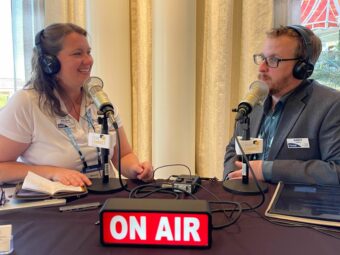
Make subscribers heroes, find foggy night scenarios and focus on service, not speed. Those are a few of the broadband storytelling ideas StoryConnect hosts Andy and Megan share from the annual Calix software conference.
Transcripts have been lightly edited for clarity and readability.
Intro: A production of Pioneer Utility Resources. StoryConnect, helping communicators discover ideas to shape their stories and connect with their customers.
Andy Johns: What are some of the major takeaways from the 2023 Calix Connections Conference? That’s what we’ll be talking about on this episode of The StoryConnect Podcast. My name is Andy Johns, your host with Pioneer.
Megan McKoy-Noe: And my name is Megan McKoy-Noe, also your host with Pioneer Utility Resources.
Andy Johns: We’ve never done this before. We’re going guest-less with no guests. It’s kind of like when growing up, when Bugs Bunny and Garfield were both on the same cartoons to tell kids not to do drugs and like a crossover thing. That’s exactly what this is.
Megan McKoy-Noe: This is a crossover crossing the streams. They say never to do that, Andy.
Andy Johns: Here we are.
Megan McKoy-Noe: All right.
Andy Johns: We are live at the Calix Connections Conference. We’ve recorded a bunch of great podcasts with folks the last few days. Just a lot of good broadband marketing minds here at the conference. And Megan and I want to take just a couple of minutes just to share some of our takeaways, some of the things that we learned. There are so many great things that you learn both inside the sessions and outside the sessions. And, you know, some of the notes I have are even from outside the building where we’ve learned some other stuff too. But, you know, Megan, this was your first time coming to the Calix Connections Conference. What are some of the things that you’re going to take away that you learned, that you heard discussed, that you’ll remember after we leave here?
Megan McKoy-Noe: Oh, yeah, it’s been such a treat to be here because, you know, I’ve got a background in the electric cooperative world and public power world. So coming to Calix has been like a deep dive in the world of telcos and broadband. And I even had one of my new friends. I’ve made a lot of new friends here, Andy.
Andy Johns: It’s true she has.
Megan McKoy-Noe: But my dear new friend, John from Urban Utilities, at one point we were walking through the hallways and he said, “You know, we keep talking about [how] we’re broadband service providers, but I don’t really see that we provide a service. I think we are broadband serving providers.”
Andy Johns: Ooh.
Megan McKoy-Noe: Ooh. We got deep really fast.
Andy Johns: I like.
Megan McKoy-Noe: I don’t know that –.
Andy Johns: Just diving in.
Megan McKoy-Noe: – I was expecting that.
Andy Johns: Right.
Megan McKoy-Noe: But, you know, it’s so true. And I gave him a hug after that because I’m like, my wheels are turning. You’re right. And just getting to be in this place where everyone is sharing ideas and we’re all so focused on making life better in the communities we serve, has been fun. And the session started off, like the whole conference started off, with a really powerful message from the Calix CEO, Michael. And I don’t know his last name.
Andy Johns: Weening.
Megan McKoy-Noe: Okay.
Andy Johns: Weening looks like weening, but I think they pronounce it V-eening.
Megan McKoy-Noe: Fair enough. So Michael took the stage, and I loved that he had pictures on the stage behind him. At one point it was all of the logos from a lot of the utilities that they serve, and they partner with, and the impact they’re making. But my favorite part was the pictures of all of the people that help fuel and give feedback. Like it seems like, and again, I’m still fairly new to all of this. You did give me the “Telecom Bible” when I first started working for you.
Andy Johns: Newton’s Telecom Dictionary recommended for everybody. Yep. Great reading.
Megan McKoy-Noe: But to be here and see how Calix is so focused on the members and and their partners and having their feedback, it really inspired me for Pioneer to make sure that we’re listening and have the feedback lines open for our own members. So for all of you out there listening, all of our friends of the pod, tell us what you think about us. Please, help us be better.
Andy Johns: I do think they do a really good job, and I feel like they always have done that. This is about number six for me to come to this one, but this year in particular, it seems like a lot of faces. A lot of making Calix customers the heroes out here. Which is exactly what we we tell our folks, you know, the Pioneer members to do, is to make their customers or their members the heroes. And it’s the same kind of thing to see Calix take that into account. I think we do some of that at Pioneer. We could always do a little bit more of it. But one of the things you were talking about, the opening session, one of the things that stuck out to me was a quote from the CEO, Michael Weening. He said something to the effect of, you know, when you’re too busy is when you decide whether or not to live out your company values.
Megan McKoy-Noe: Ooh.
Andy Johns: And I think that’s – yeah, right.
Megan McKoy-Noe: You got deep as well, so.
Andy Johns: We’re four minutes in, and we’re all kind of stuff. So you know, to me that’s a good reminder that it’s very easy, especially with all on the broadband side, all of the funding that’s out there. Everybody’s building in new areas. People are launching new brands. But it’s when you’re busy that some of those colors shine through as to where you really put those values. And that was a good thing for me to hear.
Megan McKoy-Noe: Yeah, it’s very true. And this conference has certainly been busy and packed with so many different sessions. I’m not sure how many you got to go to because we’ve also I selfishly have loved the time that we’ve had just interviewing folks on the podcast. Because that’s when I get to hear some of the amazing things folks are doing with their local schools and ways that they are listening to their members. But I did get to sit in a couple sessions, and my favorite was Ann Handley. Had you heard about her before?
Andy Johns: No, I was not familiar.
Megan McKoy-Noe: Oh well. And she made it Christmas themed, which was fun. But she said if Target can put Christmas trees up in October, then she can share Rudolph the Red-Nosed Reindeer in October as well.
Andy Johns: No argument here.
Megan McKoy-Noe: No, but her session was talking about brand positioning, and she said that emotional connections drive decision making. And I didn’t realize that Rudolph the Red-Nosed Reindeer was a story that was written for a department store.
Andy Johns: Oh, I hadn’t heard that.
Megan McKoy-Noe: Did you not know this?
Andy Johns: I didn’t know this.
Megan McKoy-Noe: So she talked, I believe his name is Robert May was the author. But he would write copy about, you know, men’s shirts and describe it in catalogs. And they wanted to bring people into their stores, and they asked him to write some sort of a children’s book for Christmas. And he did, and it became this huge phenomenon. And she broke it down for everyone, why it was important. But it all came down to understanding the customer and positioning your business in the right way to be there for them, and then crafting stories that make people feel. And she explained how he did that with the Rudolph story, going down to who is the hero? Who is the, you know, what is your foggy night? So you may not be familiar with the story of Rudolph the Red-Nosed Reindeer, Andy.
Andy Johns: You know, I do recall the most famous reindeer of all, as they say.
Megan McKoy-Noe: Andy, with your story so bright, no. There is a foggy night scenario. And I think for all of our members, our subscribers, what is their foggy night? What issue are they dealing with, and how can you make them the hero? Because Rudolph isn’t the hero of the story, it’s Santa. Rudolph is the product.
Andy Johns: The guide. Yeah.
Megan McKoy-Noe: Yeah. So he is the solution that you’re offering to get them through their foggy night.
Andy Johns: Interesting. Yeah, kind of a different twist on that whole Donald Miller story brand. Well, you have the book. You picked up the book here.
Megan McKoy-Noe: I got the book for free. Thank you Calix.
Andy Johns: When you get into that book, you’ll understand more about that because it’s classic. Another storytelling piece that I had taken away was actually outside of the event. We went to the Penn and Teller Show on one of the nights that we were here. And I thought, one of the things that, you know, Penn said it because Teller doesn’t talk. But one of the things that Penn said, they had a trick. And really, after he said it, I was sitting there at the rest of the magic show thinking about it. He said that one of their tricks towards the end, he pulled a black cloth off of a cage, and there was a chicken in it. And he said, as soon as I show you a chicken, you’re going to start telling yourself a story about what you think is going to happen next. And if you think about everything that they did and the Penn and Teller Show is different every time. So I’m going to go ahead and say what happened and not give away too much because it changes. But by the end of the trick, we were all thinking the chicken was going to disappear. But when he moved the thing, there was a person in a monkey suit inside the cage.
Megan McKoy-Noe: It was a real monkey.
Andy Johns: It was either a person in a monkey suit or a real monkey. I know which one I would bet on. And if you think about it, so many of their tricks take a story or a narrative that we’re made to think is going to happen, but then it kind of flips it on its head. And I was just reminded how that can be a very powerful storytelling tool. You know, we always say that in the absence of a narrative, people are going to create their own.
Megan McKoy-Noe: They always do.
Andy Johns: And if you know whatever it is at your company, that’s a way to kind of do that customer delight. You know, they think that when they come in, they’re going to sign-up for service. Or they think when they call about a program, or they think when they interact with you, it’s going to be a certain way. The chicken is going to disappear. But then all of a sudden, if you throw in a monkey –
Megan McKoy-Noe: A real live monkey.
Andy Johns: The metaphor breaks down at some point. But if you throw in something that they don’t expect, that’s the way to change that narrative, to make that delight, that customer delight. Didn’t expect it. And it could be a pretty powerful storytelling tool that I don’t know if it’s one that I’ve always focused on, but I thought that was a powerful example from outside of the classroom.
Megan McKoy-Noe: Well, I would also say, you know, talking about flipping the narrative a bit, one of the other messages that stuck with me from a general session, they were talking about innovating and how to – I think it was simplify your message, excite your consumers, and grow from there. Right? And as he was talking about that, he said, you know, to excite your members, you have to really find a way to connect with them to figure out what matters to them. And we have to switch up our storytelling. We’ve been focused too much on speed. And he said, speed doesn’t matter. Folks don’t care.
Andy Johns: Speed is the start.
Megan McKoy-Noe: Speed is a start.
Andy Johns: Speed is a start. Yeah.
Megan McKoy-Noe: But that can’t be your full story.
Andy Johns: Right.
Megan McKoy-Noe: You know, and I think as communicators we’ve just been used to saying, “Oh well, and then we’re going to now offer, you know, this many gigs. And now this many gigs.” And we’ve got to stop focusing on the number of gigs, and instead focus on what the gigs give. Right. And that was an interesting point for me just to change. And we talk about that a lot, at least when I’m hosting episodes of The StoryConnect Podcast, we talk about starting with why and focusing not on what we do or how we do it, but why we do it in the first place. So, you know, why does broadband matter to a gamer? Why does it matter to a rancher? We had someone that I was talking to today from Minnesota, and they were talking about wanting to create a program just for ranchers, like, how will this make a ranchers life better? And how can not talk about gigs at all, you know? And so it’s really tailoring it to how does this give you a better life.
Andy Johns: How does it get the rancher through the foggy night to go back to what you’re saying.
Megan McKoy-Noe: Yeah.
Andy Johns: And that was exactly where I was headed. By the way, I do know that’s what you talk about on the episodes that you host, because I listened to at least the first 35 minutes of all of your episodes.
Megan McKoy-Noe: Oh, come on.
Andy Johns: At least the first 35 minutes.
Megan McKoy-Noe: I get excited when I hear ideas, and I just so. Y’all can also vote on how long you prefer your StoryConnect podcast episodes to be. I tend to go about 25 minutes. I would say on average.
Andy Johns: I had written, you know, 92% of the time we’re in perfect agreement on stuff. And I had written that down as my next point to talk about too that, you know, the idea that it was a different way to put it. But one of the speakers talked about it, that a ten gig network is an investment decision, not a go-to market strategy. And he said, you know, you build a network like that, so you won’t have to reinvest in another one in 15 years or 10 years or whenever the speed demand goes up. It’s not a go to market strategy. They talked about how if you do just focus on speed, like you were talking about, it becomes a commodity that, you know, then everybody’s just fighting over price. But the analogy that I thought worked really well from one of the speakers here was talking about a truck as a platform. And he had the trucks up on the screen. And he talked about how a broadband service can be that truck. And then on top of that, does somebody need it built out to be a bucket truck? Does somebody need it to be built out as a, you know, more of a compact truck? Do you need, you know, all the tool boxes built on it? Do you need it to be a flatbed? All the different options of how you could do that truck. But it’s still the chassis, the frame, the engine is all still there.
Megan McKoy-Noe: It’s how you get there. It’s what drives everything right.
Andy Johns: And to be able to have a service that you’re offering, you know, you’ve got to start with speed like we talked about. But then finding ways, whether it’s a rancher like you talked about, whether it’s a school, whether it’s work from home folks, gamers, as you mentioned, just finding ways to kind of customize that with add ons to be able to make it something that’s more meaningful to them. That was a good analogy that I hadn’t heard before, and I appreciated that one.
Megan McKoy-Noe: I think during that same session, he mentioned an ad that came out like a week ago, two weeks ago about storm hardened Wi-Fi.
Andy Johns: Right, from one of the big cable providers.
Megan McKoy-Noe: One of the big cable providers. And I know when I saw that, I thought, “Oh, that’s really cool.” And I shared it with a couple of folks at Pioneer, and they were like, well, everybody can do that. This is not a new thing. But it was a new way to repackage something that you already can offer to people. And again, it’s talking about looking back at what we do and finding ways to share that story a little bit differently. Thinking about it from the foggy night point of view, storm hardened Wi-Fi is really good marketing. It’s something that a lot of us could – it’s battery backup. That’s what it is, right? But just thinking about it from the consumer’s point of view is smart.
Andy Johns: Yeah. And they were to the point. I mean, that’s a whole other part of it too, that even if that battery backup was important 4 or 5 years ago for 911 calls and things like that, the fact that we’re at a point and the need for broadband, where your lights are out, your power’s out, that’s fine. At least you can still stay on Wi-Fi as long as you know your laptop has a battery or, you know, whatever it is there. It’s an interesting commentary there. I think the other, probably the last takeaway for me was just everybody here is talking about the NPS, the Net Promoter Score. And I know that we’ve had a couple of podcasts talk about that. I’m not sure exactly the order whether we’re going to release this podcast first, whether they’re going to release it last.
Megan McKoy-Noe: Oh, these could be teasers. It could be like if you stay tuned to the podcast with the amazing Kelly Burns.
Andy Johns: Yep. Um, you know, and we discussed in other spots too. And I know one of the ones that we talked about with Hunter Communications, they said NPS is not the one they look at. They look at more the Google reviews and the social media reviews. But on almost every session, people are talking about Net Promoter Score, which is a concept I’m familiar with. We’ve done a little bit with it here and there, but it’s something that 5 or 6 years ago people were not talking about. So I’ve asked a few people here, what is it that, you know, why do you think that is? That NPS, the Net Promoter Score, has been something everybody’s talking about. And they said like everything, COVID had a pretty big impact on that. That, you know, (a) like you said there, more and more folks that are providing that speed. So it’s not just a competition on speed, but they said that the way that we all rely on broadband so much more now than we did before Covid, that that Net Promoter score really has been the main metric they’re using to see how things are going. A couple of folks said it was more of an all encompassing number, and they could even look at it and say, “Okay, if our NPS is rising, if our Net Promoter Score is a certain height, we can plan on more business. We can expand on more. We can make that investment because we know people are happy, and we know that generates more business. And that was just an approach that is a lot more prevalent, a lot more just all over the place at this conference than I had ever seen before.
Megan McKoy-Noe: I love it. It’s been a lot of fun. Thanks for letting me come.
Andy Johns: Absolutely. Well, absolutely. It’s been been a great couple of days here at the Calix Connections Conference. I think that about wraps it up for us. We’re going to be packing up, and we’ve appreciated the time from all of our guests who have come by here. And of course, appreciate Calix for putting on the conference. I don’t know how to do this with two of us on here.
Megan McKoy-Noe: He is Andy Johns.
Andy Johns: She is Megan McKoy-Noe. And until we talk again, oh, do we want to say it at the same time?
Megan McKoy-Noe: Yeah. I think so.
Andy Johns: Oh, no, I was going to do. Until we talk again,
Megan McKoy-Noe: Keep telling your story.
Andy Johns: There we go. Thank y’all.
Outro: StoryConnect is produced by Pioneer Utility Resources, a communications cooperative that is built to share your story. StoryConnect is engineered by Lucas Smith of Lucky Sound Studio.