Share

In Kansas, one utility is handing out branded cash to use at local businesses during festivals. Hear Erma Ratliff share the idea behind Kanokla Cash to see if the idea could help you cash in on community growth, too!
Erma Ratliff
Transcripts are lightly edited for clarity and readability.
Intro: A production of Pioneer Utility Resources. StoryConnect, helping communicators discover ideas to shape their stories and connect with their customers.
Megan McKoy-Noe: How can subscribers cash in at community events? That’s what we’ll be talking about on this episode of The StoryConnect Podcast. Hi, I’m your host, Megan McKoy-Noe, one of the storytellers here at Pioneer Utility Resources. And I am joined by Erma Ratliff, community engagement and events coordinator at Kanokla in Kansas. Erma, thank you so much for joining us today.
Erma Ratliff: Thank you for having me. I’m excited to be here.
Megan McKoy-Noe: Well, I’m excited because we were talking about this at StoryConnect. And I am like, I haven’t heard of somebody just handing out cash at events. It makes so much sense. I’m excited about this. But before we dive into Kanokla cash, can you start us off by telling us a bit about your telco and the communities that you serve?
Erma Ratliff: Yeah. So Kanokla, we are a small rural broadband based in Caldwell, Kansas. We started in 1951, in Harper County, and now we are all over south central Kansas, northern Oklahoma, helping bring internet to rural communities.
Megan McKoy-Noe: Connecting people to what matters most. I love it. It’s exciting. So let’s get down to the cash. What is Kanokla cash, and how can I get some?
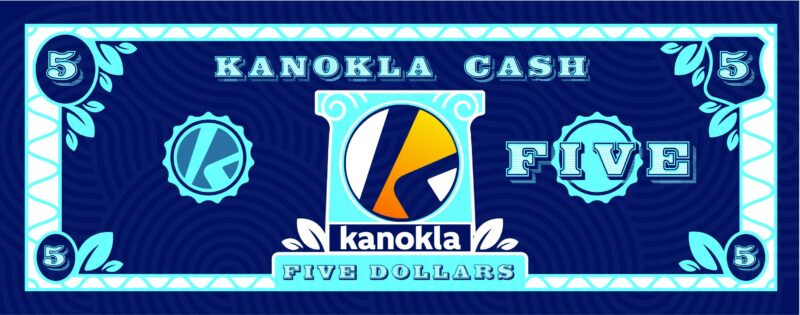
Erma Ratliff: All right, so this is Kanokla cash.
Megan McKoy-Noe: Oh, it looks like a dollar bill. It is not a dollar bill’s colors though. It is shades of blue.
Erma Ratliff: Yeah. It’s like our Kanokla colors. We rebranded a few years ago, so we put our colors on here. Kanokla cash is just a form of money that we hand out during events to bring people to our table, and it gets money out to local businesses as well.
Megan McKoy-Noe: Well, you’re saying it gets money out to local businesses, but what can I use this money for? I come by, and I have this really snazzy, well designed cash looking item, but with your colors. So you’ve got the blue, you’ve got the orange in there. It looks really nice. Where can I use it?
Erma Ratliff: Yeah. So usually we get with local vendors, like say we’re going to a fair. We go to all the local vendors who are going to be at the fairs or the restaurants in the town, or the even clothing stores in the town. And we’re like, “Hey, we are coming to your event. We want to support you as a small business. And by doing that, we’ll tell people to come by our table to pick up their Kanokla cash, and then they’ll take the cash to your business.”
Megan McKoy-Noe: Ooh, is it like a dollar, or is it $5? Do you give out $20?
Erma Ratliff: And so yeah, we do $5. So if a family comes in and tries to get more information, it’s $20, sorry, $20 for families, and $5 for singles. But then they can use that kind of like a little discount card at that business.
Megan McKoy-Noe: I love that. So where did the idea for this come from?
Erma Ratliff: So I’m actually on the chamber board in Wellington, Kansas, and we do Wellington Bucks. So people can come in and buy these bucks like gift certificates. They can use it at all the local businesses there as well. So that’s where I got the idea of how Kanokla could use this in our communities, that we serve for different events.
Megan McKoy-Noe: I really like this, and I haven’t heard of anybody else doing this yet. Hopefully we spark some ideas for other utility pioneers. So you said families get $20 single subscribers or members, do they have to be a subscriber?
Erma Ratliff: No, they don’t have to be subscribers or anything. They just have to come up and get more information about Kanokla. Most of the areas that we have tested this in is new areas that we’re going into. So we’re like, “Hey, don’t forget to stop by Kanokla’s table to get your Kanokla cash to use at any of these participating vendors.” And we usually a couple days before the event, we have a list of all the vendors that are participating in it accepting the Kanokla cash, and they usually share the post, so it’s really helps engagement everywhere.
Megan McKoy-Noe: Yeah, I can imagine. How much cash have you given out so far?
Erma Ratliff: So far it’s probably been around $500. So it’s nice to have like a budget. So you’re like, “Hey, we have this much.”
Megan McKoy-Noe: Budgets help.
Erma Ratliff: Yes, budgets help a lot. So once you know your budget, you can kind of go from there and see how much cash you want. Like if you want $5 increments, $10, $20 however you want.
Megan McKoy-Noe: I have to ask, have you thought about having one of those tornado boxes where the air goes around, and there’s like dollar bills and everything, and maybe there’s like $100 special bill in there that they try to get.
Erma Ratliff: No, but that is a good idea. I haven’t thought of that. Like one of those money machines where you just grab it and things.
Megan McKoy-Noe: Exactly. Yeah.
Erma Ratliff: That’s actually a good one. Yeah.
Megan McKoy-Noe: I’m just saying you could build off of this. This is very exciting. Once you’re giving this out. So you have do you have a set budget for how much you’re giving out all year?
Erma Ratliff: Not all year. We usually just do it per event.
Megan McKoy-Noe: Okay.
Erma Ratliff: So far it’s just been around $500 per event. But it gets people in there fast and. A lot of these communities we go into, they’re not overly huge. But it’s a good to give back to the areas.
Megan McKoy-Noe: Oh definitely. So have you run out? What do you do when you run out of cash?
Erma Ratliff: We have not ran out yet or gone over budget, thankfully. But that would be something a good problem to have because then you know that people are spending those dollars locally.
Megan McKoy-Noe: Well, and I have a feeling because you just started this the summer of 2024. So how many events have you been to so far?
Erma Ratliff: So far with this, probably only 3 or 4. We hope to obviously grow next year as we get more involved in the communities we’re serving.
Megan McKoy-Noe: Is there any other information that’s on your Kanokla bucks about your – I know it has your logo on there and the denominations, so the amount of money. Does it list where you can spend it, or a website to learn more about the telco?
Erma Ratliff: So these ones actually do not. But the ones that we did have previously had expiration dates on them. And we also talked about changing the colors up. So maybe have more yellow instead of blue. So that way people, because some of these communities we serve are super close. So that way they can only use that during that event instead of trying to save it for the next event.
Megan McKoy-Noe: Oh, so they can’t just have all of these to use, like save them up over a year and –
Erma Ratliff: Yeah. No. Yeah. You can’t hoard the Kanokla cash. We really want you to support those local businesses during the event that they’re participating in. So yeah.
Megan McKoy-Noe: Oh, okay.
Erma Ratliff: Yeah you have to turn them in that night.
Megan McKoy-Noe: Okay. So you have to use it right away, and you let them know that. Do you have any banners or signs at your booth that explain that to them? I know you said vendors help.
Erma Ratliff: Yes, we have a little information paper that we put along with the Kanokla cash to be like, “Hey, this is what it is. This is where you can take it to, and this is when they expire.”
Megan McKoy-Noe: Okay. Excellent, I like that. So you’ve been using these, you said at fairs and festivals you’ve done three events so far. How did folks react when they got them?
Erma Ratliff: Well, at first people were like, “Hey, I want that.” And then I explained to them, and then like once people start taking it to different businesses, they’re like, “Oh wait, where’d you get that at?” So then they come to the table to get more information, and then get the Kanokla cash. So it’s been really well received.
Megan McKoy-Noe: That is wonderful. Did you, were you able to grab some pictures of people using their Kanokla cash and share it on social?
Erma Ratliff: Yes, ma’am. Yeah. It’s been well, and I know the vendors like it because, like they said, sometimes people wouldn’t go to their place until, like, it’s free money. So people of course, why would they not use it?
Megan McKoy-Noe: Why would they not like free money? I love free money. Yes. So that makes so much sense. So we’ll have to include a couple examples of the social media posts that you were able to get and what this looks like at pioneer.coop/podcast, so folks can see it and kind of get excited about this idea. What are your plans for the program in 2025?
Erma Ratliff: Yeah, we hope it grows, and hopefully we are able to reach out to more vendors and businesses next year when we go to these different events, especially next summer with fairs and festivals, and then really even go into, even the smaller events like we have Oktoberfest coming up and different Christmas stuff. It’d be really nice to use at some of our Christmas events coming up.
Megan McKoy-Noe: Well, and the vendors, I assume just bring you whatever cash is redeemed at their business and then you just –
Erma Ratliff: Yeah, we just pay them right then and there.
Megan McKoy-Noe: Yeah, I love this.
Erma Ratliff: It’s nice for everyone involved. Again we’re supporting – we’re a small business, so we’re supporting other small businesses in the local community. So people see that like okay, they’re supporting our local business, so why should we not support them?
Megan McKoy-Noe: And while everybody loves free cash and this is an amazing idea, I also know how important it is to track the folks that you have engagement with like this. So in order to get the Kanokla cash, do they have to give you their email address or sign up any? I know they’re coming by your booth, but do they have to give you any of their information while they’re there?
Erma Ratliff: So far we have not made people commit to giving us any information. Really, we really just want to tell them, like, “Hey, we’re here. We’re supporting you guys.” But that is something maybe we could look at into the future.
Megan McKoy-Noe: Just curious, because if you have, you know me, Erma. I get excited, and I start spitballing and brainstorming. Because you could. If they’re excited about this, you could have a list. Find out what else you’re doing in the community. Where else they can get Kanokla bucks or Kanokla cash in the future, and maybe tell them about other promotions that you have, too. But I get that y’all aren’t doing that yet, because you really do. I love this as a story about strengthening your community. It’s like giving out grants, but folks are deciding which vendors they want to support, and you’re still putting that money into the community and helping the small businesses that need it. So, I’m excited. One last question before I let you go. If a utility wants to create a program like Kanokla cash, how should they start?
Erma Ratliff: I think the big thing is to have a budget, because a budget’s really huge, especially like, oh, hey, I got this. And then really know your audience, like, what kind of, where are you going? Are you going to a fair with more animals, can you do something with that? Like, “Hey, this local, this kid has homemade bread. How do you support that little kid who has homemade bread? Can you give him some of your cash?” And just different things like that, just knowing your audience, and how to support other businesses?
Megan McKoy-Noe: Well, I am excited to see Kanokla cash in action across your community, and I’m hoping a lot of other folks will just hear your idea and go, “Oh, we could totally do that. That’s brilliant.” So thank you so much for sharing your story with utility pioneers. She is Erma Ratliff from Kanokla, and I’m your host Megan McKoy-Noe at Pioneer Utility Resources. And until we talk again, keep telling your story.
Outro: StoryConnect is produced by Pioneer Utility Resources, a communications cooperative that is built to share your story.