Share

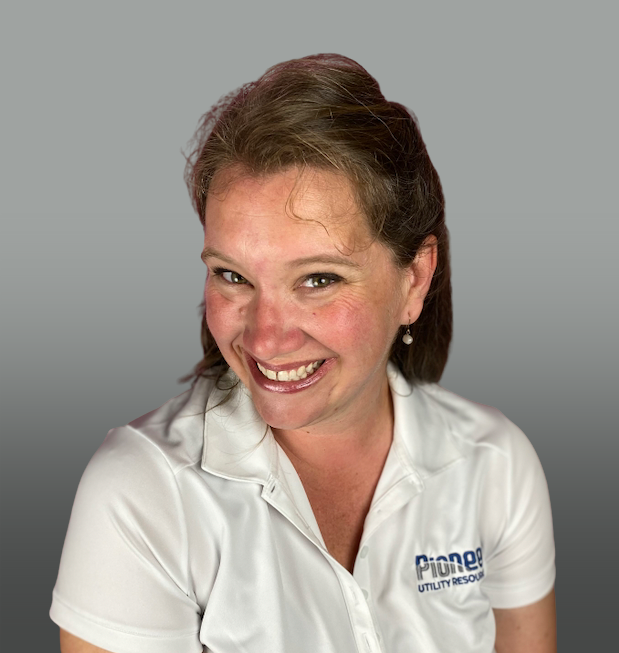
Ian Cope at Grays Harbor PUD joined Utility Pioneers from across Washington at PUD Day on the Hill. As an elected official himself, he shares the best storytelling prompts to keep government officials engaged in your story.
Ian Cope
Transcripts have been lightly edited for clarity or readability.
Intro: A production of Pioneer Utility Resources. StoryConnect, helping communicators discover ideas to shape their stories and connect with their customers.
Megan McKoy-Noe: Goats, scarves and more. How can you share your story with elected officials? That’s what we’ll be talking about on this episode of The StoryConnect Podcast. Hi, I’m Meghan McKoy-Noe, one of the storytellers at Pioneer Utility Resources and your host. Today I am joined by Ian Cope, communications and government relations director at Grays Harbor PUD in Washington. Ian, thank you so much for joining me.
Ian Cope: Thanks for having me. Good to be with you.
Megan McKoy-Noe: It’s always fun to learn from you. Now, Ian, you are in this very unique position. You balance government relations with storytelling at your utility. Why is it important to share your story with government officials?
Ian Cope: I think they need to know about the decisions that they’re making and the decisions that have an impact on utilities. And the best way to do that is those face-to-face meetings. We’re lucky in Grays Harbor in that we’re just a stone’s throw away geographically from Olympia. We have six state representatives and senators that represent Grays Harbor County. So we’re able to sit down and meet with them. We have good relations with them, and we just want them to know when they take a vote how that’s going to impact the people that are in their districts.
Megan McKoy-Noe: Nice. So you’re keeping your story front and center with them. Now, I thought it was really fun that in addition to your role as a utility storyteller, which is how I have known you for a long time, you have been a city councilman for the city of Montesano since 2015, which made me wonder, how does your storytelling style shift between consumers when you’re sharing your story with them and elected officials? And what kinds of stories make the most impact with elected officials?
Ian Cope: I think the personal ones make the most impact. If we have a customer who has been impacted by some piece of legislation or a rate or some program that we offer that maybe the the electeds can take a vote on that’s going to either enhance or take away from. To know that, you know, this person is going to be impacted this way. Actually being able to put a face on it is the best way to do it. It’s always best to to actually put the human side on it and to let them see the impact that it actually has on a person is the best way. I mean, we can talk policy all we want, but to actually break it down to the human level is always going to be the most impactful way to do it.
Megan McKoy-Noe: I like that. Now, in February, you joined other public power communicators for PUD Day on the Hill at the Washington State Capitol Building in Olympia. Could you tell me about why you were there?
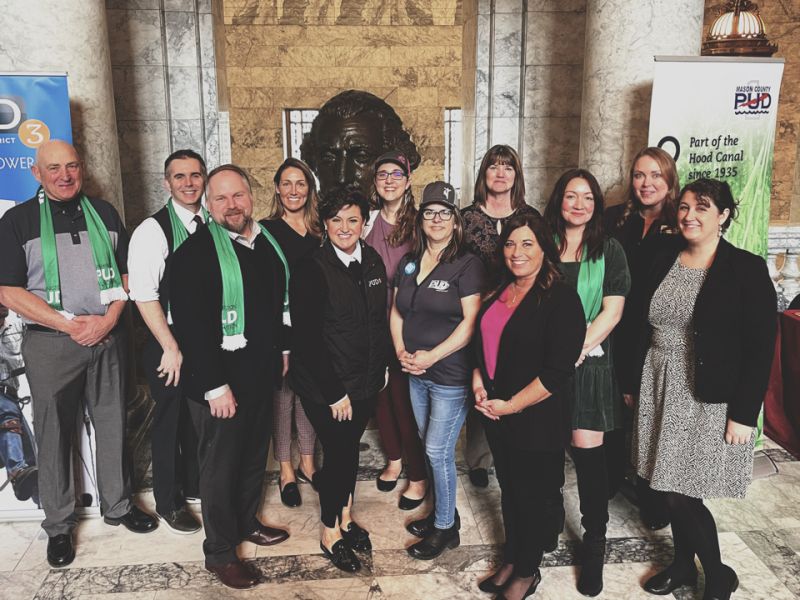
Ian Cope: So it’s something that not everyone gets to do to actually set up in the rotunda of the Washington State Legislative Building. Beautiful building, and to actually be able to set up in the rotunda, set up tables with PUD materials to actually be able to do that is something, as I said, not everyone gets to do. So to be able to do that and to share information, whether they be giveaways, literature, show t-shirts and hats that we’ve made and things like that, and just tell the public power story. Not a lot of people really know about the importance of PUDs and what it is that they do and how they provide them. They only think about electricity when it goes off and when they open their bill. So we actually want people to to know about what we do and to hear about what we do and and see us. And to be out there in the public and actually putting a public face on a public entity, I think it’s really important. And we were able to do that and at the same time meet with our legislators and talk to them.
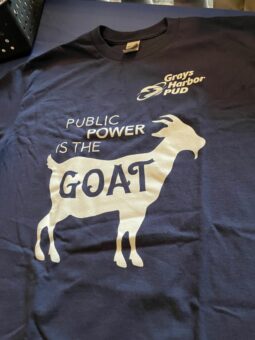
Megan McKoy-Noe: Now, you brought up putting a public face on public power, right? But you did. I heard about something very fun that Grays Harbor did, and you shared it at your Day on the Hill. So I’m just curious, can you talk to me about your goat shirt?
Ian Cope: Okay. So this actually goes back to the 2022 Grays Harbor County Fair. And the theme of the fair, we always have a booth out there for the four day run, and we have t-shirts for all of our staff. The theme of the fair was a “goat load of fun.” And you know, I’m very punny, but so as we were coming up with what our shirt design was going to be, all this talk about, you know, is Simone Biles, the greatest of all time? Is Tom Brady or Joe Montana, the greatest of all time, the GOAT. And so we just thought about that, and strangely enough, I was just walking around thinking, Gee, what should our fair shirt be this year? And I thought, “Public power, GOAT. Public power is the GOAT. It’s the greatest of all time.” So that’s where it came from.
Megan McKoy-Noe: I love that for folks.
Ian Cope: And it took off. We’ve had a lot of people that are like, gee, isn’t being a goat a bad thing? And we’re like, “Oh.” But most people see it and they think, “Oh, GOAT – greatest of all time.” They get it. So it’s just a way to tap into the fair theme and tapped into what we feel about public power, and it was a nice little confluence of messaging.
Megan McKoy-Noe: And you’re continuing to milk the idea in 2023. You’re welcome.
Ian Cope: Yes, indeed. It lives on. And funnily enough, we had a lot of people come up and say that, “Hey, you know what? We really love those shirts. Can I get one?” So and this is from other utilities. We had a couple of legislative assistants come by and ask, “Hey, can I get one of those?” So yeah, definitely. I’ll get them to you. I’ve got a box of them sitting right over here. So I’ll be making sure that that people that wanted them get a hold of them.
Megan McKoy-Noe: So for folks who have not, who weren’t there, and haven’t seen the shirt, it has your logo on it. And then can you explain the other message on the shirt?
Ian Cope: If I am allowed to stand up and grab one for a second here, I could. I should’ve had one right here with me. I apologize.
Megan McKoy-Noe: No, no. We’ll put a picture of it on our website. So when folks are hearing this podcast later on, they can always check at Pioneer.coop, and in our podcasts to see this. But just quickly, for folks listening in the car or at home, what is the main image on this?
Ian Cope: It is. So it’s the PUD logo, and it’s public power. And then it is a screenshot of a goat. And again, a lot of people looked at it and thought that, you know, being a goat is a bad thing. You know, you’re the goat of the Super Bowl. Usually you miss a field goal or something like that. But no, it’s just a screenshot of a silhouette of a goat, and then it’s got public power is the goat on it.
Megan McKoy-Noe: I love it. I love it.
Ian Cope: It just mixed in perfectly with the fair theme. And everyone was talking about GOATs from greatest of all time from a sports side of things. So we just, like I said, it just came together nicely, I thought.
Megan McKoy-Noe: Have you thought about having a goat mascot for Grays Harbor, anything like that?
Ian Cope: You know, we haven’t. It wouldn’t be a bad thing. I mean, who doesn’t love, I mean, people one of the things that they want to feel better about the world, what do they love to do? They look at images of baby goats running around and jumping on top of things. So, yeah, I think having a goat mascot would be fantastic.
Megan McKoy-Noe: Okay. Okay. I’ll look forward to hearing about those developments later. April 1st might be a great day for y’all to come out with that.
Ian Cope: But who would feed it?
Megan McKoy-Noe: Who would feed it? This is true. Well, I noticed that you and a few other utility pioneers like Alice at Cowlitz PUD and Will from Jefferson County PUD, wore matching green scarves in the pictures that I saw from the PUD Day at the Hill. Where did those scarves come from?
Ian Cope: They are from the Washington Beauty Association. It’s just kind of the identifying feature. You know, a lot of, some people, when they come to the Hill, they all wear the same t-shirts. Some wear buttons. A scarf, a green and white scarf, was the kind of the attire that the state PUD association WPUDA choose. And that’s one that has stood the test of time. I think that we have used them for many, many years. I want to say four or five years, they’ve been the kind of identifying mark of WPUDA when we are up there on the Hill, handing out coffee in the morning, and then meeting with legislators, going down to the barbecue that they put on. It’s always one of the best attended events. You know, you feed a legislator, they’re going to come. And so, it’s always great to see people there. And yeah, the green and white scarf is just kind of that identifying badge of this is WPUDA. This is our attire that we’re wearing, and you see those green and white scarves, you know where they’re from.
Megan McKoy-Noe: I love that. That’s a really easy thing. Sometimes we try to do nametags or we’re matching shirts, and then that doesn’t always work very well. But if you have scarves, it’s super easy just to put them on somebody, and you’re good to go. So that’s kind of a fun idea. I also noticed that some folks, including the powerhouse storytellers, Sheila at Okanogan PUD, Kristin at Mason County PUD, and Lynn at Mason PUD 3. They set up tables in the rotunda. What types of storytelling props did you and other utility pioneers use at the Capitol, and what seemed to be most effective? What item that you had at those tables really helped you share your story?
Ian Cope: I think that the giveaways that you have, the swag that you have, whether it be hats, whether it be the t-shirts, stress balls, hand sanitizer, it draws people in. And then you get the conversations going because, you know, with public records being what they are, people don’t necessarily want to take away a lot of literature. And, you know, they’re moving through quickly. They’re on their way to meetings. They’re on their way to hearings, or taking something to their member or going to another meeting. So it’s got to be quick. So you draw them in with the, you know, the swag, so to speak, and then you’ve got them there as a captive audience. When they’re sitting there, “Oh, can I take a stress ball?” Or “Oh, can you tell me about this?” It’s just a good opportunity to get them there, and then you’ve got them in that one-on-one. I think that’s something that is so much better now that that we’re coming out of the pandemic. We’re actually able to meet with people. We’re actually able to talk with people. And, you know, as great as a t-shirt is or a brochure is, to have that one-on-one interaction, to actually be able to talk to someone, that is always going to be best. And that’s, I think, what how we best share our message and all of us really enjoy doing that.
Megan McKoy-Noe: I love it. Now, you mentioned stress balls a couple of times, which I assume would be pretty helpful for government officials, especially nowadays. But is that, I mean, is there a certain type of stress ball that you all used that people really like? Or is there like one big item that everybody talks about beyond the goat shirt obviously?
Ian Cope: Oh, I think that the one that we saw the most there, and Alice and I got into a competition. We were right next to us, Alice at Cowlitz. We were right next to each other. She had the little squeeze bottle of hand sanitizer. I had the spray hand sanitizer. So we got into a little hand sanitizer battle, not throwing it back and forth at each other. That would just be weird.
Megan McKoy-Noe: Good. Thanks for clarifying.
Ian Cope: But that was the one that I think that we had that we talked about a lot. And again, the stress balls are just something that we you know, when we go to the fair, hand them out to the kids. Every kid loves to get a ball that they can throw around or a plastic helmet. And the plastic helmets are always going to be a hit with the kids. Coloring books, things like that. Just things to draw it in because you think about it, if you go to a school or something like that and the kid comes home to his parents, what did you do today? Oh, the PUD was there, and they’ve got their hat. They’ve got their coloring books and safety information, something like that. It’s a chance to spread the message and let the parents know that the PUD is there, and we’re out in the public, and we’re sharing information. It’s just another kind of aspect of sharing the public power story.
Megan McKoy-Noe: I love that. Well, before I let you go, is there anything else that you want folks to think about as they look for ways to share their story specifically with elected officials?
Ian Cope: Again, we can finally be back one-on-one with people. We can actually have those meetings. Take them when you can. It’s the best way to get it out there. We’ve lived online for two and a half years, plus we’ve had phone conferences and things like that. But just getting out there and actually talking to them and letting them know that if you have any questions, if you’re taking a vote on something and you want to know how it’s going to impact your utility or any area where you’re taking a vote on something, give us a call. Just make your set. Let them know that you’re there to help them be the most informed legislator, the most informed representative or senator, that they can be, and that you’re there to help them and be their trusted advocate and source of information for utility information.
Megan McKoy-Noe: I love it. Well, thank you, Ian, so much for sharing your story with our family of utility pioneers. He is Ian Cope, communications and government relations director at Grays Harbor PUD. And I’m your host, Megan McKoy-Noe at Pioneer Utility Resources. And until we talk again, keep telling your story.
Outro: StoryConnect is produced by Pioneer Utility Resources, a communications cooperative that is built to share your story. StoryConnect is engineered by Lucas Smith of Lucky Sound Studio.