Share

Retirements and competitive hiring makes storytelling critical for staff retention. How can you introduce new team members to your culture and keep them happy? Kathryn Green at Southern Rivers Energy shares her co-op’s onboarding process, which turns the first few days on the job into memorable moments.
Kathryn Green
Transcripts have been lightly edited for clarity and readability.
Intro: A production of Pioneer Utility Resources. StoryConnect, helping communicators discover ideas to shape their stories and connect with their customers.
Megan McKoy-Noe: How can you introduce new employees to your co-op story? That’s what we’ll be talking about on this episode of The StoryConnect Podcast. Hi, I’m Megan McKoy-Noe, one of the storytellers at Pioneer Utility Resources and your host today. I am joined by the amazing communications specialist extraordinaire Kathryn Green from Southern Rivers Energy. Kathryn, thank you so much for joining us today.
Kathryn Green: Thank you for having me. Now, I have to live up to that amazing introduction.
Megan McKoy-Noe: Oh, you’ve been living up to it for years, trust me. Well, we were talking earlier, and I should mention, we, if you hear any background background noise, we call it ambiance. We are at the Beyond Power Conference in beautiful Chattanooga, Tennessee. And we have folks from Kentucky and Mississippi and Tennessee and Georgia and just all over the place coming together to trade ideas. And Kathryn, you and I were talking in the hallway, and you shared a really cool thing that y’all are doing to onboard new employees. Talk to me about what you created at Southern Rivers Energy.
Kathryn Green: Absolutely. In the past, new employees either came to Southern Rivers if someone died or retired. We never had job openings. As awful as that sounds, that is the truth. Co-ops, that’s where everyone wanted to work, and no one left. And that’s still the case to an extent. But with, especially after COVID, there was a huge shift in people being able to work from home. There was an uptick in projects that could recruit linemen and pay them triple what we could pay. There were a lot of conditions and a lot of factors that really played into the part of losing new hires. And so in the past, we had maybe a ten year span when we hired 15 people total. In 2022, we hired 12 new employees. So that means that those are 12 people telling our co-op story that might not even know that we’re a co-op. So the communications and marketing department teamed up with our human resources, and we came up with a resource guide and an actual gift to get these new employees when they come that teaches them all about co-ops.
Megan McKoy-Noe: Okay. So you’re saying a resource guide. Is this like just a piece of paper to help them out, like on the back of a business card? Or is it something more than that?
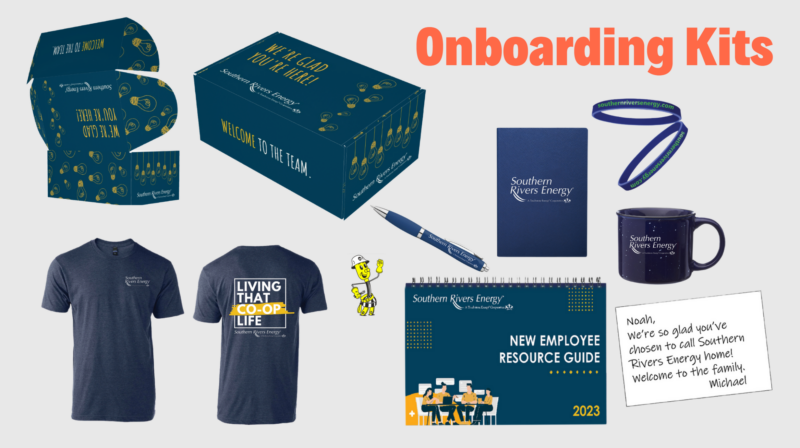
Kathryn Green: It’s a little bit more than that. So in the past, I would rummage through my closet and try to see what t-shirt size they were. Maybe I had it, maybe I didn’t. And you know, they’d say large. And I’m like, “Oh, will a medium or extra large work?” Like it was not intentional at all. But I mean, it was still, “Okay, we want you. You’re here. Let’s give you some swag.” And so that was our onboarding program. And so now this is a very intentional gift. So we created a box that is all – graphics on every inch of this box. And it has our logo. It has light bulbs, and it’s “Welcome to the Team.” You know, “We’re glad you’re here.” So it’s an intentional gift. They open it. It’s all color coordinated, and it’s a shirt that emphasizes the fact that we’re a co-op. Only new hires get it. So of course, all the other employees are extremely jealous. They get a notebook. They get pens. They get little rubber bracelets with our website that they give to their kids. They get Willie Wiredhand stickers, which is, you know, amazing. They get a co-op connections card. But the most important piece is a resource guide. It’s spiral bound. It’s about, I’d say about 20 pages. And it covers our statewide. It covers NRECA. It covers Touchstone Energy, our fiber project, and it covers how we’ll communicate. An ideal employee whether, you know, okay, your job description might shift, but we want you to be open minded. We want you to ask questions. And so it gives us a chance to say, “This is what we’re hiring you. This is what we’re looking for. This is what we hope that you could be.” And it sets those expectations, but it also gives them – it has pictures where they can see those key staff members so they know exactly who to go to with questions. And they’re not just out there wandering around aimlessly. Like it gives a specific guide of just tips and helpful hints for them.
Megan McKoy-Noe: Right. It sounds like it’s really setting the tone for having a more fulfilling cooperative culture at Southern Rivers Energy, which, I just, you know, I get excited about co-ops. And too often, especially when you have a churn like this, y’all lost a lot of your co-op storytellers, and a lot of that love that you built up over many, many years. Tell me. I think ,you showed me a picture, and we’re going to put a picture on our website so folks can see the shirt and the whole package and the way it all came together. But what is the message on the shirt?
Kathryn Green: So the back of the shirt, we, of course, have Southern Rivers on the front, but the back is “Living That Co-op Life.” And co-op is kind of highlighted, but, you know, we’re really driving home the fact that we’re a co-op. That it’s different. That we’re not your normal energy provider. And one of my favorite pages of the whole resource book, it’s got several employees smiling at a member, and it’s saying, you know, right now our members don’t have a choice who their electric provider is. However, we treat every member and every interaction as if they did have a choice, they would choose us. And that’s really the message that we want to drive home, because it’s not always the communicator or marketer out there dealing with the members. It’s our CSRs and linemen. And we had a situation, not a situation, but one of our board members had a job at their house. So we sent a crew, and it was an apprentice lineman who had been there very short amount of time. And thank goodness they said this is a board member. However, if they did not, you know, I mean, that was a potential interaction that the person didn’t even know they were going to a board member’s home. You know, and who’s to say that they didn’t go to church with them and know them personally, but we still wanted to make sure like, “Hey, this is what a board is. This is why we have it. This is who’s on it.” You know? So we really wanted to have those conversations in a casual way that wasn’t after the fact of going, “Hey, you really shouldn’t have, you know, been eating a sandwich in the driveway or whatever.” I mean, you know, you just never know what happens in the field.
Megan McKoy-Noe: Well, and with storytelling, it’s so important. And I know y’all would treat, and do treat, everybody equally at your cooperative. But it’s important to introduce characters in storytelling. And if you have employees coming on board, and they don’t understand that there’s a board, they don’t know the key characters, then they can’t tell your story effectively or show your story in the community. So I love that you all are equipping them with those resources. For folks that have been there for a while, do you do any refreshers for them so that they can kind of remember? Or if they forgot a little bit about why being a co-op is important. It’s just always been that way. Do you have refreshers on co-op education for other employees?
Kathryn Green: Absolutely. So all that to say we have the best employees at Southern Rivers. They are phenomenal. And it’s one of those things that this whole kit is reinforcing the co-op and the mindset of our whole family. And we really do say “welcome to the family” because that’s how it is. There’s such a gray area among departments where if I needed help with absolutely anything, I could go, and I feel supported with anyone in the co-op. And we jump at opportunities to help each other. And that goes for our day-to-day job duties or information or questions or anything. And so as we were making this, there was a lot of feedback with the staff members of “Okay, what do you want to include from your department? Or is all this information correct?” And, you know, and every single one said, “I learned something from this,” you know. And so now at the end of every single monthly newsletter, and we took out some of the new employee stuff, but at the end of every newsletter is a link to the SRE Resource Guide. And, you know, it covers family companies and what they do. Or, you know, anything that they might need to know about Southern Rivers that maybe they’ve been there for 12 years, and they’re scared to ask. Or they don’t even know what to ask.
Megan McKoy-Noe: We don’t know what we don’t know. And so I love that y’all are providing that opportunity to help educate all of your employees and remind them and make sure that they can easily find the information so they don’t have to admit that they don’t remember quite what it is. Now, I know you said you had folks reviewing some of this content. Did you create all of it from scratch, or did you start from something that you already had? Because we always love talking about cat content, right? Make sure every piece of content has nine lives. Where did you start with this resource guide?
Kathryn Green: A little bit of everywhere. So the majority of the information actually came from our Youth Tours study guide. So we put out, and it’s on our website, SouthernRiversEnergy.com under the Youth Tour. And it is just kind of a co-op 101 and Southern Rivers. There’s QR codes for videos linked to NRECA. And it is as we were putting it together, so many people go, “This is incredible.” Like, you know, this is a good resource. And so that’s kind of how it evolved. And then we tailor fit it to exactly what we needed. But one of my favorite aspects of this is, and this year is our first year launching it, and so as new employees come, we kind of figure out what works and what doesn’t. And we have now shifted to where we give this box is we invite the new employee to a staff meeting. So you have all the key staff members in a room. We take up five minutes at the very beginning welcoming them. They get introductions all at once, which is a little overwhelming, but still the ultimate message is “We are so glad you’re here. This is an incredibly special place to work, and everyone in this room wants you to succeed.” And that is the tone. They get welcomed by the supervisors of every department. And so it’s a special welcome where, you know, and we hope that from day one they know that they’re special. Research shows that within six months an employee knows if they’re going to stay or not. And we really want to make that good impression up front. And emphasize like, here are all the reasons that you want to stay here, and one day you’ll become our old employee instead of our new one. You know.
Megan McKoy-Noe: Experienced employees. We never age.
Kathryn Green: That’s true. That’s true.
Megan McKoy-Noe: Well, and so that begs the question. I was imagining that they came in their first day, and they had that box in their work area.
Kathryn Green: And sometimes it does kind of work out that way. So we’re actually giving our next one on Tuesday. So our new employee, he is joining our meter department on Friday. And so his first day of job shadowing is Friday. And then our next staff meeting, we have them every other week. And so it’s often, and so then on Tuesday, he’ll be welcomed in, and so he’s probably already met some familiar faces by the time. So that kind of helps too. So he’s not as nervous. But it’s that unified message again that we’re just really driving home about, you know, that we’re a co-op. And this is why you should feel special to be here. And we’re special to have you here. You know, it’s a two way street.
Megan McKoy-Noe: Well, and I love that because you’re building that connection within two weeks of each new hire coming into the family. I was thinking that it might be quarterly or something. But, okay, now I feel better. All right. Within two weeks, they get that gift. They are welcomed in. And you all have been doing this for about a year. No, not that long?
Kathryn Green: No, no. It’s very new. We’ve been doing it for about three months. So we started it. Once we established it, we back fed our new employees. So we invited everyone who had been there for six months, but that covered 11 employees. And so we brought them into the boardroom. We we joked with them that they, you know, we said, “Okay, you know, new hires know within six months. You got to give us your decision today.” But, you know, of course. But we offer donuts and coffee and everyone stayed. But we just laugh and tried to make it a comfortable environment. And the feedback that we received, even without the kit, of going, you know, one of our new IT techs, he said, “I go home,” and he was talking about his fiancée fussing about some of her work issues. And he goes, “I have enjoyed every single day I’ve been here.” And I’ve been at the co-op for 12 years, and I could say the exact same thing, you know. And so it’s that joy. I’m glad that that is resonating even without an official onboarding, even though that that’s important, so that they know what what type of company they’re working for. But at the end of the day, the culture makes all the difference for a warm welcome.
Megan McKoy-Noe: I love that y’all have found a new way to share your story with the onboarding process, because as we know, everybody is fighting to retain staff, especially now. So storytelling. It all comes down to storytelling. Before I let you go, is there anything else that you want to share that has worked, not just for new employees, but for keeping other employees engaged with your co-op story?
Kathryn Green: I would definitely say just communication. And even if you think you’ve told it 7 or 8 times, do ten more, because the more you tell it, the more that it resonates. And then the more people will see it. You could, you know, as a communicator, I know that I feel like I’m bugging people. But then there’s that one person that goes, “Oh, I didn’t know we had a co-op connections card,” you know, or whatever it might be. And so those messages, if we just keep repeating them, it does resonate. But at the end of the day, it’s the relationships. So if you build those relationships with those, you know, the other departments, anyone from the maintenance to a lineman to a CEO to an accountant, all those relationships matter because then you could cross those lines and say, “Okay, I’m a graphic designer. Can I help you with anything? Is there anything you need me to design or create for you that will help? Is there anything you need me to communicate to the members?” So those relationships is what makes our job easier and happier. So all about the storytelling.
Megan McKoy-Noe: It’s all about the storytelling and the relationships that you make along the way, which is why I love being able to meet with you at a conference like this, because I’ve been a fan of yours for many, many years. Not that many, but a few years. We’re not that old or experienced. Well, thank you for sharing your story with other utility pioneers. She is Kathryn Green from Southern Rivers Energy. And I’m your host, Megan McKoy-Noe, at Pioneer Utility Resources. And until we talk again, keep telling your story.
Outro: StoryConnect is produced by Pioneer Utility Resources, a communications cooperative that is built to share your story. StoryConnect is engineered by Lucas Smith of Lucky Sound Studio.