Share

Are you generating Pink Power? Since 2011, lineworkers at Baldwin EMC in Alabama have worn pink hard hats each October to educate the community about different types of cancer. They even have a PINK BUCKET TRUCK (name TBD). Learn how you can wear pink to share your story.
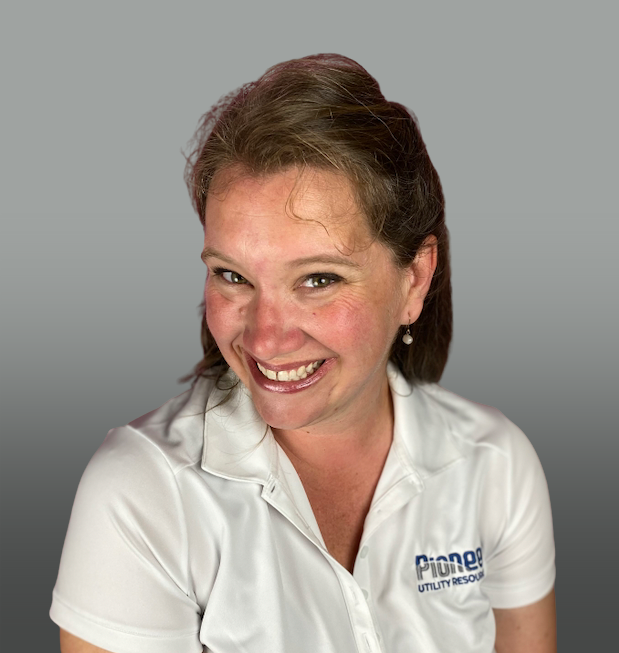
Michelle Geans
Transcripts have been lightly edited for clarity and readability.
Intro: A production of Pioneer Utility Resources. StoryConnect, helping communicators discover ideas to shape their stories and connect with their customers.
Megan McKoy-Noe: How can a pink hard hat transform your story? That’s what we’ll be talking about on this episode of The StoryConnect Podcast. Hi, I’m your host, Megan McKoy-Noe, one of the storytellers at Pioneer Utility Resources. And I’m joined by Michelle Geans, community relations specialist at Baldwin Electric Membership Cooperative on the Alabama coast. Michelle, thank you so much for joining me today.
Michelle Geans: Well, thank you for having me. I’m so glad we’re able to have this conversation. I feel like we’ve been in the planning stages of this for –
Megan McKoy-Noe: Oh, I know.
Michelle Geans: I don’t remember how many months, so I’m excited.
Megan McKoy-Noe: A long time.
Michelle Geans: Long time.
Megan McKoy-Noe: Well, I mean, I’ve been a fan of what y’all are doing at Baldwin EMC for a very long time and right now am wearing a pink hard hat that your team sent me more than a decade ago. So I think it’s high time that we share this very colorful story of community and staff engagement. So to get us started in a nutshell, can you just tell me what is pink power?
Michelle Geans: Well, for us at this point, pink power, to sum it up, is an education and advocacy campaign that Baldwin EMC is so privileged to be able to bring to our local community, whether that’s member groups, civic clubs, community organizations, schools, anyone that we have an opportunity to bring that outreach to. It’s also an internal fundraising campaign which our employees have rallied behind for more than a decade now and are just so eager to support every year and really look forward to it. And I’m just so blessed to see how it’s grown since its humble beginnings.
Megan McKoy-Noe: Yeah, it started back in 2011, I believe, and I love the campaign.
Michelle Geans: It’s so hard to believe. 2011.
Megan McKoy-Noe: I know, it was just like yesterday, really.
Michelle Geans: I know.
 Megan McKoy-Noe: But I love the campaign tagline that y’all have. “Shine a light on those in the fight.” I’m curious. It’s been around for a while now. Who came up with the idea for Baldwin’s line workers to wear pink hard hats all month each October?
Michelle Geans: Well, this is one of those stories I love to share because this is one of those opportunities where we get to talk about how you never know where lightning is going to strike. And so this story really began with this pink hard hat. This is my hard hat that I’ve had for several years. I’ve changed out the insides. Don’t worry to anybody who’s worried about the safety regulations on that. We were doing some office construction several years back. I think this was 2010. And as a communication specialist at the time, I was tasked with taking monthly pictures of the progress for our board. And in order for me to go on these construction sites, I needed to have a hard hat of my own. I jokingly said to our warehouse and purchasing manager, “Well, can you get me one in pink?” And they kind of just laughed it off like, “This girl’s nuts.” Well, that same particular day I had that conversation, I show up at the job site with my white hard hat, and I see a female construction worker there who had on a gorgeous pink hard hat. And I thought, “Oh, they do exist. Oh, my goodness.”
Megan McKoy-Noe: It’s not a myth.
Michelle Geans: So I just said something half joking, half serious to our contracting manager at the time. And next thing you know, a week later, I had a pink hard hat of my very own, showed up on my desk. And so fast forward a few weeks, I’m back on the job site with my pink hard hat pulling up to go back to the office. Walking into the building. I have my pink hard hat kind of tucked under my arm, and one of our at the time crew chiefs on our right of way department, Ivy Knight, he pulls up in his pickup truck in front of me, and he says, “Hey, that’s what we need for the guys to wear, that pink hard hat.” And I was like, “Okay, Ivy, what’s the punch line? Let’s go. Gurly man. What do you want to say?” And he goes, “No, no, for Breast Cancer Awareness Month in October.” And, of course, my jaw hit the floor, and I thought, “Oh my gosh, what a great idea.” He said, “The fire department’s wearing pink. Football teams are wearing pink. Why can’t we wear pink hard hats?” And I said, “Friend, I don’t know if you’re joking, but I’m about to run with [it].” So I immediately went to Karen Moore, who at that time was our VP of Member Services and Communications and who is now our Chief Executive Officer.
Megan McKoy-Noe: Yes, she is. She’s a lovely.
Michelle Geans: And I said, “Let me tell you about this idea that just came out of blue skies, courtesy of Ivy,” who is still with us. He’s a superintendent. Now. I said, “What do you think?” And she said, “Well, we maybe could do it, but let’s see if our guys would support it.” And, of course, they did. They were all very eager to do it. We were able to secure the hard hats, and from that the campaign was born.
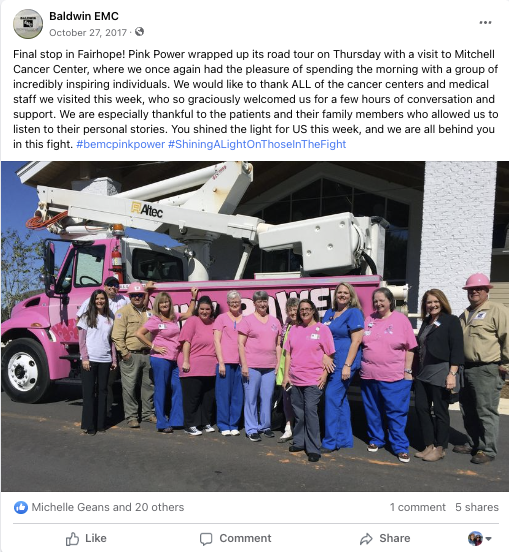
Megan McKoy-Noe: Oh, I love this. But you didn’t just stop at pink hard hats, as amazing as they are. And I know several other utilities do this now, you know, I keep seeing them every now and then. These pink hardhats pop up. But you didn’t stop there. Talk to me about your glorious pink bucket truck and your road tour.
Michelle Geans: This has been one of our more recent additions. When we first launched the Pink Power campaign, we knew right from the get go that we wanted it to be more than just something to look at. It couldn’t be just a pink hard hat just for the sake of pink hard hats. We really wanted to make this, like I said, an education and an advocacy campaign for our community. And so the components continue to grow. We continue to get feedback from our employees, especially those who actually wear the pink hard hats on a regular basis. And the idea for a pink bucket truck kept coming up, and it was one of those, “Oh, that’s so farfetched. Oh, that’s so farfetched. Oh, we could never.” And then you know how gradually if you have the conversation long enough, it goes from “Oh, we could never do that,” to “Could we though?” And working with our wonderful transportation department, we had a bucket truck that was decommissioned. It was out of service and wasn’t being used for day-to-day operations. And our transportation supervisors said, “You know, we think we could make it work. We can get this one back up to code.” We found a company that was willing to wrap a bucket truck in bright pink with a pink power logo and tagline. And it has become one of the most recognizable symbols of Baldwin EMC’s community outreach ever since. I have been in it. It is glorious.
Megan McKoy-Noe: I would imagine. So, does it just go out in October, or can you see it throughout the year?
Michelle Geans: Oh, you can see it anytime. You can see it anytime. It makes the rounds in October, obviously. But she has been in Christmas parades. She’s gone to school programs, career days. Any time we can really kind of give some something that community outreach tagline, we try to incorporate the pink bucket truck if we can because she’s just such a sight to see. And yes, but October obviously we definitely put her front and center on display at all of our offices. And it’s really just amazing that this campaign has grown that way.
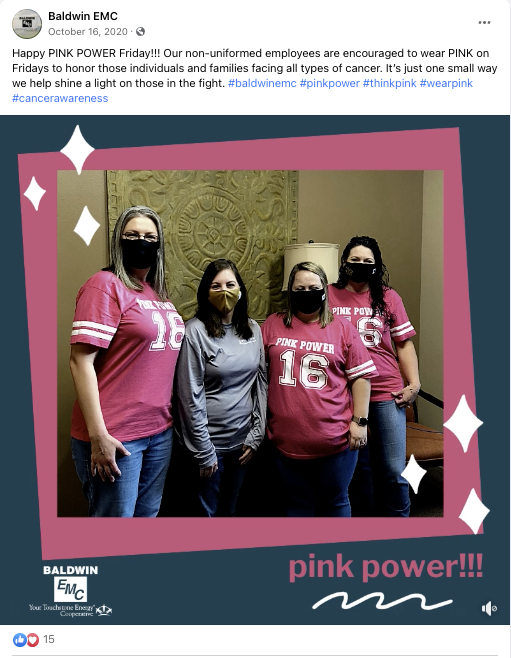
Megan McKoy-Noe: Yeah. So for the campaign, your staff, I’ve seen over the years, that y’all have done this. They have pink power shirts. Some have like, you’ll put like the year and look like football shirts. Some are traditional t-shirts. Your line workers are wearing these pink power hats. But this is not just an awareness campaign, right? You mentioned that that a lot of it now has, it’s evolved into a focus on awareness in the community. But how does Thinking Pink work as a staff fundraiser? And initially, it was a community fundraiser as well. How has this whole idea evolved over time?
Michelle Geans: Well, we have recognized that almost every one of our employees in one way or another has been touched either personally or through a family member or a loved one by cancer. And so one of the things that we have made sure evolved as part of this Pink Power campaign was this is no longer a breast cancer advocacy campaign. This is an advocacy campaign for all types of cancers. We have even updated the pink bucket truck to have the ribbons for every type of cancer that we could identify now are attached to the side of the bucket truck, just so anyone who sees it knows whatever type of cancer it has our support. And because it’s not hard for our employees to feel that sense of connection to the cause, they’re very eager to support it. Whether that’s through fundraising or wearing the shirts or wearing the hard hats or, you know, participating in, I mean, we’ve had some pretty wacky fundraisers over the years.
Megan McKoy-Noe: Oh, please do tell.
Michelle Geans: I’m not going to give all the secrets away. But there was –
Megan McKoy-Noe: Oh, I mean.
Michelle Geans: A pig and a kiss involved in one of our senior level management people.
Megan McKoy-Noe: No, that’s thinking pink in a whole different way.
Michelle Geans: I don’t know if this was flattery or not, but he got voted on by funds to kiss the pig, and he did it.
Megan McKoy-Noe: You know, again, thinking pink. I like it. I like it.
Michelle Geans: He was a team player. He probably –
Megan McKoy-Noe: Of course.
Michelle Geans: won the teamiest team player of them all for that.
Megan McKoy-Noe: But, you know, a lot of utilities will have like wearing jeans on Fridays and maybe pay a dollar to wear jeans or something like that. Do you have something like that for your Pink Power campaign that staff chip in for on a regular basis to wear their pink shirts or to buy shirts?
Michelle Geans: Yeah. So we do have Pink Power Fridays in October. It’s no cost. It’s just a celebratory thing that we do on Fridays. We wear our Pink Power shirts, and it’s always just such a cool look when we all come, and we’ve got our Pink Power on. We don’t associate a cost with that. We do other fundraisers that are completely voluntary. We do allow our employees, if they want to buy additional shirts for family members, they can. But everybody does get supplied one at no cost to them. The fundraising is more like raffles and drawings and cool prizes. We’ve auctioned off everything or raffled off everything from coolers to wreaths to gift cards. And it just it gets competitive, and I love it.
Megan McKoy-Noe: And I know that when I worked at my co-op in Georgia, I worked on our United Way campaign. So I would get a lot of donations from the community for our raffles. Are you able to get community donations to support the Pink Power campaign?
Michelle Geans: That is in the works. That component of it is not fully off the ground yet, but that conversation has circled around multiple times. It does get a little bit fuzzy on how you can take donations and what kind of tax little areas that you get into there and how does that work. And so it’s been a more difficult conversation, but it is one that we have on a regular basis because our community supports this program as well. But the external leg of this, like I mentioned, is more of an advocacy and education component.
Megan McKoy-Noe: That makes sense. And that’s how you use the road trip, the pink bucket truck travels throughout your community. And how many road trip stops do you all have throughout the year, or the month?
Michelle Geans: It changes every year. We try to make sure she makes the rounds throughout her district. So we have three district offices, South Baldwin, Summerdale and then our North Baldwin. And Baldwin County is huge. It’s about, our service territories close to 2,000mi². So she makes the rounds from the beach all the way up to the northern part of the county. And then it just depends on how many requests we get throughout the year. We get requests from school groups and different things, and that fluctuates from year to year. So we don’t have a set schedule for her every year. We just try to make sure she at least makes the rounds from top to bottom. And there I go gendering her again. It’s just stuff now. It’s just roll–
Megan McKoy-Noe: No, no, it’s all good. So I’m curious how much money, especially through the staff, how much money have you raised so far since the campaign began in 2011? And where does that money go?
Michelle Geans: I’m going to break out my calculator and give you –
Megan McKoy-Noe: Oh, dear.
Michelle Geans: an estimate here. I will say we’ve probably raised around $50,000 to $60,000. Our fundraising efforts right now are teamed up with the Guardians of the Ribbon of Lower Alabama. And they are a group of first responders, firefighters, police officers who basically do all the good work in our community for those who are fighting cancer. They not only provide financial resources, but they provide emotional support.
Megan McKoy-Noe: What kind of investment did Baldwin EMC make to launch this campaign and to keep it going?
Michelle Geans: You know, more than anything, I would say our investment has been the employee buy-in. And any penny that we have put into this campaign, we’ve gotten a just wonderful return on that investment from our community, from our employees, from people who’ve reached out to us and say, “I am a cancer survivor. What you’re doing has made such a world of difference to me. I really appreciate that.” From the kids who just see the Pink Power truck and just think, “That is amazing.” So the return on that investment has been obviously so much bigger than we can ever calculate. You know, as with any campaign, there’s cost associated, but at the end of the day, to be known as a community involved cooperative takes the effort. And we’re just so proud that this has become such a successful campaign.
Megan McKoy-Noe: I know that I have seen this campaign shared over the years. It’s been on the cover of your local edition of Alabama Living magazine. I follow y’all on social, and I see all the social posts that come through. How else are you publicizing and really sharing this story?
Michelle Geans: Well, social obviously has helped us bring this new life to this campaign because people who would not even otherwise be aware that we’re doing it, it gets called to their attention and all of a sudden they’re calling us, “Hey, can we get that truck here?” Or “Hey, how can we be a part of this?” It also calls attention to the Guardians of the Ribbon and their cause. So not only are we able to give them a financial investment, we’re also able to give them a PR investment, which again, is invaluable. So definitely a social has been one of the biggest ways that we do celebrate this campaign. We do always mention it in magazines and news releases as we can to our local media, but we are just so grateful for the life that’s taken on via Facebook and Instagram and different platforms like that.
Megan McKoy-Noe: Well, Pink Power, it began in October 2011 for y’all. But October in general, it’s a really big month for utilities, right? In addition to Breast Cancer Awareness Month, which and I know you now celebrate and advocate for all types of cancer, but it started with Breast Cancer Awareness Month. But October is also a big month for us because many of us celebrate National Cooperative Month, Public Power Week, Customer Service Week, Energy Awareness Month, Cyber Security Awareness Month, and my personal favorite, Squirrel Awareness Month.
Michelle Geans: I mean, if I had some confetti right now –.
Megan McKoy-Noe: Right?
Michelle Geans: I would be throwing it.
Megan McKoy-Noe: But do you limit pink power to October, or do you use the campaign year round? Are your staff like, do you take away their pink hard hats at October 31st, Halloween? Give them back. Right.
Michelle Geans: Oh, no, that’s probably too strong a word. “Take away.” I’m afraid. They wear them [inaudible]. So beginning in October, October 1st to October 31st, and then they store their own pink hard hat. So it’s not something where we just make the rounds, like yanking them back. And I suppose if somebody wanted to wear the pink hard hat all year long, I don’t think we’d tell them no, if they wanted to. But it’s just kind of tradition that, you know, November 1st, you switch back to the white hard hat. So October is really the peak of the campaign. It’s where we really focus most of our efforts. But like I mentioned earlier, the Pink Power truck, she’s shown up in Christmas parades, shown up at Career Day in the middle of February. It really just depends on how we can bridge that that gap and make that outreach happen. And we’re not stuck to October for that, fortunately. Obviously, October is just where most of our efforts are concentrated.
Megan McKoy-Noe: That makes sense. Now, you have been at Baldwin EMC for more than, is it more than 16 years now?
Michelle Geans: Almost 17. Actually, [inaudbile] 17 years on July 17th. It’s my golden birthday, and I’ve had many people tell me that is not a thing.
Michelle Geans: It was a big deal to turn your number birthday on your the day of your birth date, right? So I was born March 8th. When I turned eight, I remember feeling like I was queen of the world because I was eight on the eighth. Now I’ve been here 17 years on the 17th. And I’m trying to, like, get on board with how important this is. And everyone’s like, “You are not getting a cake.”
Megan McKoy-Noe: I mean, it’s one of the reasons that we’re interviewing you right now to celebrate your golden birthday.
Michelle Geans: Thank you for recognizing that because I have a lot of people to get on board here with that.
Megan McKoy-Noe: I’m officially on board for you, Michelle.
Michelle Geans: You always are.
Megan McKoy-Noe: So now, over now, almost, and by the time this airs, 17 years that you’ve been with the utility, you’ve been working in graphic design, communications, and then more recently, really focusing in on community relations and improving an already wonderful feeling the community has about Baldwin EMC. How do you feel, and how have you seen – over your golden years – how have you seen this program impact how your staff and how the community feels about Baldwin EMC?
Michelle Geans: Well, at Baldwin EMC, we like to say that we are a community service agency that provides power. It’s one of those identifying things, you know, community focused, community involvement. Meeting the needs of the people you serve. Beyond just the electricity, it’s just woven into the fabric of who we are as co-ops. And this campaign so beautifully fits into that. And it’s one of the most visible ways that we as a co-op identify ourselves in that way, and we support that mission. Our community sees us that way. You know, it’s us really, to use the cliche, putting our money where our mouth is, because we do talk about how important community involvement is to us and being community focused. And this is a way that we back up those claims. You know, our employees see that too, and our employees see that we’re not just talking the talk, we’re walking the walk, and they can be a part of it.
Megan McKoy-Noe: Yeah. Concern for community is so important to what we do and telling that story. We forget to tell that story sometimes. So I love that y’all have found such a bright and colorful way to show that story and tell that story for more than a decade now. One last question before I let you go, Michelle. What advice do you have for somebody who wants to start a Pink Power, or for telcos, maybe a Connect to Fight Cancer campaign at their utility?
Michelle Geans: Well, my biggest advice would be don’t be afraid to admire and acquire. So, go and see what other co-ops are doing, Baldwin EMC being one of them. But there are several other co-ops who have adopted this program, and it’s taken a life of its own. That’s a great way to get started, is just do that. Admire and acquire, to lay that groundwork, and then let it grow. Let it grow to suit your own community’s needs, your own employees’ feedback. When we started this campaign, if you would have told us that, okay, our next component is a pink bucket truck, I would have told you “You’re crazy.” And yet here we are. So don’t be afraid to let it grow. Don’t be afraid to entertain big ideas, but definitely lay the groundwork by seeing what’s already been done and how you can adapt it. Work smarter, not harder, because so many wonderful ideas are already floating out there.
Megan McKoy-Noe: Oh. I love that. And that’s why we asked you to share this idea on The StoryConnect Podcast, because it’s all about admiring and acquiring and being inspired. And I’m always inspired when I hear what y’all are doing at Baldwin EMC.
Michelle Geans: We are blessed to have wonderful group of employees, a wonderful management team who supports us in all walks of our community involvement, and also a community that recognizes our efforts and gets on board so easily.
Megan McKoy-Noe: I love it. Well, thank you, Michelle, for sharing your story with utility pioneers. She is Michelle Geans, community relations specialist at Baldwin EMC. And I’m your host, Megan McKoy-Noe, at Pioneer Utility Resources. Until we talk again, keep telling your story.
Outro: StoryConnect is produced by Pioneer Utility Resources, a communications cooperative that is built to share your story. StoryConnect is engineered by Lucas Smith of Lucky Sound Studio.