Share


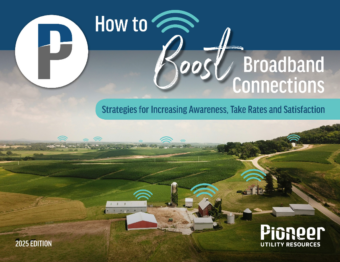 Speed and price used to be the deciding factors for broadband subscribers. Today, the landscape has changed. These highlights are from Pioneer’s peer research-based guide, “How to Boost Broadband Connections.”
For years, internet service providers raced to offer the fastest speed for the cheapest price. But speed alone is no longer enough to attract and keep subscribers.
According to Innovative Systems’ 2025 Rural Subscriber Study, 37% of subscribers don’t even know what speed tier they’re on. Most subscribers only recognize two speeds—fast and slow.
Instead, subscribers care about ease and experience. They’re constantly tuned into WIIT-FM: “What Is In This For Me?”
“If you really think about it and listen to your customers, do you know why they pick you? It’s not for your speed. It’s because they trust you. You’re reliable. You give them great service,” says Michael Weening, president and CEO of Calix.
Today’s broadband market is highly competitive, with 17% of consumers switching providers in the last two years. To keep subscribers, providers must understand and tell relevant stories throughout the entire customer journey:
Each stage requires different messaging, tools and tactics—all focused on making life easier for subscribers.
Rather than promoting technical specifications, successful providers are shifting to persona-based marketing that addresses specific lifestyle needs.
“Instead of just speed and price, we focus on things like having a small family, telecommuting, being a gamer or ‘I have teenagers,’” says Chris Lovell, chief operating officer at CLtel, Iowa. “It resonates more on the level of what people use your service for as opposed to the technical specifics.”
This approach allows providers to address unique subscriber needs:
The average subscriber has a lifetime value of $5,005, according to the National Rural Telecommunications Council’s 2024 Rural Broadband Operations Benchmarking Report. To capture this value, providers must identify and address common pain points:
OEC Fiber in Oklahoma exemplifies this approach with its proactive Subscriber Support Team. Team members reach out when they detect potential issues before subscribers even notice a problem.
“The winning service provider is the one who becomes an experience provider,” Michael says. “Understand what consumers want and then give them choices because one size doesn’t fit all.”
Pioneer’s free guide, “How to Boost Broadband Connections,” provides dozens of strategies for creating these exceptional experiences. Request your copy today to learn how to boost not just connections, but also satisfaction and loyalty among your subscribers.
We used Claude Projects to pull these ideas out of our guide, which was written by humans. AI is great at formatting ideas for different channels when you start with human-generated content. To learn more about how you can use AI to make life more efficient, go to pioneer.coop/aitools.