Share

Geni Whitehouse left a career in an accounting firm to help people tell their stories in a more interesting way. She says one key to making your stories more interesting is to understand the four types of personalities in your audience.
Recorded live: at the NWPPA’s NIC
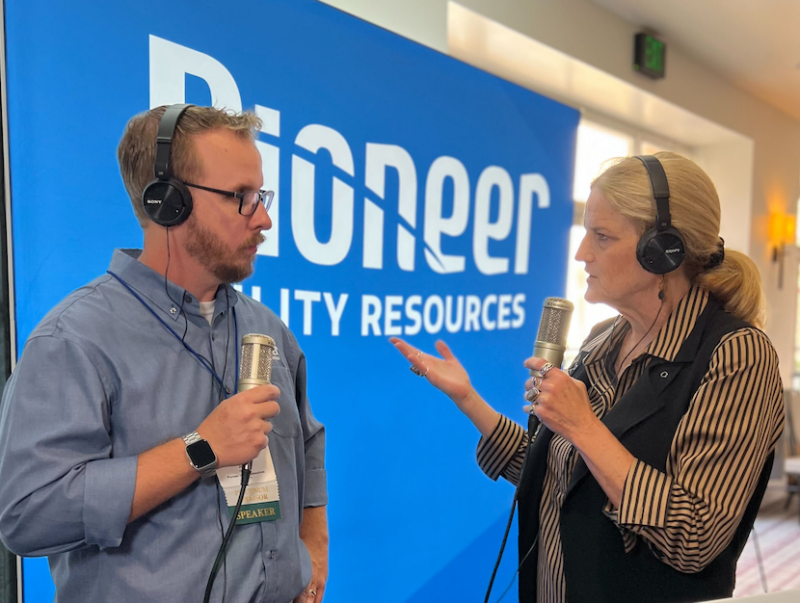
Geni Whitehouse
Transcripts have been lightly edited for clarity and readability.
Intro: A production of Pioneer Utility Resources. StoryConnect, helping communicators discover ideas to shape their stories and connect with their customers.
Andy Johns: How can you make boring subjects interesting? And what does an accountant have to say about that? That’s what we’ll be talking about on this episode of StoryConnect: The Podcast. My name is Andy Johns. I’m your host with Pioneer, and I’m joined on this episode by Geni Whitehouse, who is the countess of communication, an author and speaker who is here at the NIC conference presented by the NWPPA here in Santa Rosa, California. Geni, thanks for joining me.
Geni Whitehouse: Thank you for having me, Andy.
Andy Johns: So you’re the keynote speaker. You just got off the stage. Pioneer was happy – full disclosure, Pioneer was happy to be the sponsor for that. But I think a lot of folks, when they saw your background as a speaker, I was like, well, that’s interesting. You don’t see a lot of folks (a) with that career track, and then (b) here to speak. So before we get in too deep in the subject matter, let’s talk a little bit about what got you to this point and a little bit about your background to be a speaker.
Geni Whitehouse: So I’m a CPA, and I spent 15 years doing taxes. And I thought my goal was to be a partner in a CPA firm. And the day I made partner, I quit. I realized that I didn’t like, I wasn’t good at doing detail work, and I had never thought about that because my goal for my whole life had been to become a partner in a CPA firm. So the moment I got to the end of the road, as it were, and I realized this was going to be it, I made a change. And I said, “I’ve got to do something else.” So I went to a technology company and actually started doing teaching. I trained on project management software. And that kind of got me in the mode. And then I went to a software company and did my first presentation to a hostile audience, and I realized that I could use humor to break down the hostility and the barrier to learning. And then I decided, well, you know, this works. I’ve got boring stuff to communicate, whether it’s technology or numbers. They’re both alienating to normal people. So I decided I need to get good at comedy. So I actually went and got stand up comedy training.
Andy Johns: Okay.
Geni Whitehouse: Which was an amazing way to see how to present. There’s a process that you can learn that has helped me in my career, and I decided I wanted to do speaking as a thing. And so then I went on the road as a speaker after that and started talking about tech and accounting. But I was really motivated to help people communicate boring stuff in a better, more approachable way. And that’s been really the driver ever since.
Andy Johns: So that’s a much needed skill set. And that was kind of the topic for today is, you know, how to make a boring subject interesting. And I thought, you know, the approach that you took was really a lot more meeting people where they are and understanding everybody’s different. I like the way that you broke it all down. You know, everybody’s seen some kind of personality profile before, whether it’s Enneagram, which I know we’ve done a little bit of, or some of the others. But here in wine country, you broke it down, the four personality types, by wine. So let’s talk a little bit about that since we’re here in Santa Rosa.
Geni Whitehouse: That’s right. It’s the same kind of dilemma that we have. When you go into a winery tastery and people think that everybody wants to drink what they – the person behind the bar – likes, and we think when we’re communicating with somebody, they want to receive information the way we like to receive it. So there’s a lot of parallels. And really coming into the wine industry was the first time I understood what it felt like when I talked to somebody using a bunch of jargon and accounting terminology, they shut down. And that’s how I felt as a first time consumer of a high end wine product. I felt alienated and dumb, and I realized if I want to communicate and be effective with clients, I need to break down that barrier. And I need to try to understand how they need to receive information and then translate. And so I’ve kind of been on that path ever since.
Andy Johns: Meeting people where they are is something we talk about, but it’s so hard to remember that. It’s so hard to keep that in mind.
Geni Whitehouse: And this takes the disk behavioral styles that I talked about, [it] takes the emotion out of the challenges we have in communication. So if I can see that it’s oh, you’re wired differently than I am. And that’s why you’re so hard to communicate with or why you’re not getting what I’m saying, then we can sit down and try to resolve that difference. I can ask you, how do you need to receive information and then tailor what I provide to you in that way.
Andy Johns: Let’s get into that a little bit because how do you – it’s hard to always keep that in mind. It’s hard to always be. And it takes a little bit of getting to know people.
Geni Whitehouse: Yeah.
Andy Johns: So you know, do you recommend that staffs do an exercise kind of understand that in a formal setting, or is it more of an informal like, let me learn you a little better, and you learn me a little better?
Geni Whitehouse: I’ve done it with teams in all kinds of different settings. You can have people take an online assessment where everybody gets a detailed report, and then we share insights from people. Like I have people read out, what things should you not do when communicating with me? And invariably it’s something that I’m already doing while I’m presenting to that person. So we talk about it. But that’s a huge understanding when somebody says, I hate it when this happens, and everybody else goes, “Oh no, we’re doing that all the time.” So that’s one way. But I have a card game that I play with people where I have them pick words, and then you watch people pick the card so they have a deck with 36 cards in it, with one word on each card. And you tell them to pick the five words that best describe it, which we did a similar thing today.
Andy Johns: Yeah.
Geni Whitehouse: When you watch the way people work through that deck of cards, you can identify what behavioral style they are from that. But also the cards are color coded on the back. So then you can put them in categories. But that exercise I think is a really fun way to see how different because the high seas, which is the detailed orientation, will take that 36 cards and go through every single one and count out the ones that don’t fit first, and then really narrow it down because they want the 100% right answer. And they will always say five words is not enough.
Andy Johns: Okay.
Geni Whitehouse: So you can see things like that. So it’s a really fun way to show how different we think, whether it’s, you know, the scientific answer or not. So there are lots of ways to bring this into team activities and communication.
Andy Johns: It’s not even about the words they pick. It’s like you said, watching them pick how to pick.
Geni Whitehouse: Yeah. It’s so shocking. And the high D’s, which are the results driven, they just want to get-er-done as it were, will just pick out the first words and stop. And they’ll be done before anybody else. They’ll be sitting there tapping their fingers on the table going, “Okay.”
Andy Johns: “What now?”
Geni Whitehouse: Yeah, it’s just fascinating.
Andy Johns: Well, let’s run through it. And you’ve mentioned a couple of those personality types. So obviously, you know, the presentation you just gave I think was about 45 minutes. So we’re not looking for the whole rundown of all of it. There’s a lot more to get into. And we’ll talk about the book. You know somebody wants to get into more of it there as well. But let’s kind of run over those four primary personality types that you talked about.
Geni Whitehouse: Yeah. And their behavioral styles, not personality, which is a distinction. It’s how I behave, not who I am or my personality, which is why I like it. Because I’m an accountant. I can’t talk about personality. I don’t have one, right? So I got to avoid that whole area.
Andy Johns: I think anybody who saw the presentation would argue otherwise, but sure.
Geni Whitehouse: Thank you. So the first dimension is D for dominance. That is the results orientation. I just want to get it done. It doesn’t matter how I do it. The second dimension, and we all have all four of these dimensions in our behaviors. We just move different aspects up or down. And we are wired by default to be a particular way. So the D is first for dominance. The I is the influence dimension. And those are people who are motivated by relationships. And then the S dimension is for steadiness. And those are people who are team players who are motivated by security. They’re looking for stability. And these are the people, 40% of the population around the world, across cultures, and they are the people who keep everybody else functioning. They are the critical players who don’t need to be in the spotlight.
Andy Johns: I have a few of those people in my life that I need very much, yeah.
Geni Whitehouse: They’re amazing, and the rest of us are very lucky to have them because the world would fall apart otherwise.
Andy Johns: Right.
Geni Whitehouse: And then we have the C, which is for conscientious or compliance. And that is typical accounting orientation. That’s a detail focus motivated by accuracy. And again we need all four of these in every organization. We need to hire for differences. We need to fill in sort of the spectrum of different behavioral styles so that we have a complete set of people that can function and produce great output.
Andy Johns: Got it. So and then each of those coincided, just because we’re here in wine country with the different kind of wines. Let’s speak to that real quick.
Geni Whitehouse: Okay. So the D, I paired with a big bold cab, and we talked about Screaming Eagle. And they had a Magnum, which is what, that’s the representation of a D dominance of bold. And then for the I, we had a sparkling wine. I picked one from Gloria Farrar. She has a cuvée which is a blend of multiple vintages. It’s bubbly. It’s sparkling. It’s all about the party. For the s I chose, The Rose, a rose from Flowers, which is a great local winery, and that rose can be blended from any kind of fruit. You can have any underlying red that you use to produce a rose. So it’s a team player. It can contribute. It doesn’t need to be in the spotlight, but it can pair with all kinds of different things. It’s widely used and consumed in this area, in the Napa Valley and Sonoma counties. And then the final one was the C, and I chose Grgich Chardonnay. That is a classic year after year, award winning wine. It’s been around for a long time, and it’s made in the classic style. So it’s something that a high C would be comfortable with. They would have the research to back its value, and so that’s why I paired it that way.
Andy Johns: I appreciate the metaphors. And somebody who’s just learning a little bit about wine. That’s helpful for an overview there too. So you get some bonus knowledge for the folks listening. So all right, we’ve talked about the personality types. Now, let’s talk about putting those into practice. So when you are communicating, and you start to kind of learn who the other person is, whether it’s formal or informal. What’s the next step? What do you do to try to talk to those folks, obviously depending on their personality type, it’s going to be a little bit different as the best way to communicate with them. Right?
Geni Whitehouse: So the thing about DISC is, it’s observable, which is why we accountants use it. Because we can get clues from the person we’re talking with. So one is what kind of eye contact do they have? Where do they sit relative to you? How fast do they approach the room? How do they want to start the conversation? And then once we get some of those clues, then we can modify what we communicate. So if I know you’re a high C, and I’m an I, I don’t want to get all bubbly and start talking about the weekend. I want to start saying, you know, maybe how are you doing? And then let’s talk about what we’re working on, and then give you some facts or data, depending on what I’m trying to accomplish in that conversation. If I’m talking to a high D, I’m going to say, okay, here’s what you asked for and give it to you. If I’m talking to an I, we’re going to build a relationship because now I’m an I with an I, and so we’re going to have a party and probably not get anything done. And neither one of us is going to know what the heck just happened.
Andy Johns: And that’s why I’m worried this podcast may run long if both of us go on. So we’re trying to limit the bubbles here.
Geni Whitehouse: That’s right. And then so that’s what’s going to happen. If I’m talking to an S, I’m going to make a personal connection again. And then I’m going to try to be more organized so that I don’t throw them off with my lack of structure and organization.
Andy Johns: Perfect. And then so how does that play into, you know, the topic of the book, the topic of the session, how to make a boring topic interesting?
Geni Whitehouse: Yeah. Well, you find a method that works. So for the high D’s, it’s typically a visual is the quickest way to communicate. So you have some people here on the floor that are doing dashboards. That’s how to communicate information about power usage to a D and to many people. But the D particularly because they’re only going to want to look at a one second something. They have a very short attention span. The I is going to want to know about the people that are involved in whatever’s going on. So, and I was talking in my session, if you’re going to do a newsletter, I want to learn about the team that I’m working with. I want to connect with the people. If it’s an S, I’m going to want to know safety and security around what’s happening with whatever you’re sharing with me. And if I’m a C, I’m going to want detailed information, so I can evaluate whatever you’re talking to me about.
Andy Johns: And it’s so interesting talking to a group of communicators here, because that applies whether it’s a website. You’ve got to have that for everybody. If it’s a newsletter or magazine, you’ve got to have that to speak into everybody. So, you know, there are the folks on, and we’ve seen it from web traffic that we do. Certain folks are going to go straight to that team page, and they’re going to want to read the bios of the team members. Others are going to want to see, you know, the uptime numbers or the some of the reliability and security measures in place. So it’s fascinating how that plays out in almost every communication channel.
Geni Whitehouse: And what was really fascinating today is we did a live poll of the group, and I had them match. We did an exercise to match the behavioral styles, and the percentages lined up perfectly with what the standard percentages are across the world. So 40% are typically S’s. And I think we had 37% of the room that was S in our group. So it was really fascinating to see those percentages line up exactly around group norms. But yeah, we can’t just present information the way we would want to receive it. We have to think about everybody else and try to put something for everybody in everything that we deliver. So provide a handout or a link to some detailed factual something or all the detailed stats. If somebody wants to go look at it, a picture for the ones who want that. Like if you put everything in video form, I don’t want to do videos because it takes too long.
Andy Johns: Sure.
Geni Whitehouse: I want to see the transcript. So you do the video, the transcript. You have a, you know, the summary or a, you know, the outline or whatever for different audiences so that you can connect everybody. And I’m sure you’re already doing all of that like that.
Andy Johns: You know, everybody’s doing some of that to varying degrees. So we’ve talked about written communication. But you know, as a speaker who, you’re sounds like from our conversation yesterday, you’re doing more and more of this. Maybe there’s somebody who’s doing a board presentation or whatever it is where you, you know, you’ve got whether it’s 9 or 10 people or 100 people in the room.
Geni Whitehouse: Same thing.
Andy Johns: How does this apply when you have a whole bunch of different people who are probably going to be broken down into the different behavioral types?
Geni Whitehouse: Well, there are 52 tips in my book, and one of them is put the boring stuff on a handout.
Andy Johns: Oh, I like it.
Geni Whitehouse: So if you’re doing it to a board particularly – and I have a board now that I’m accountable to. I’m in a tech association. I’m president of that, and I have a board that I have to report to. And I send them in advance all the boring crap, the details of all the financials, the budget and all of that. And then we just say, I want you to approve these three things, and that’s on a slide. And that’s all they have to deal with in the meeting. So do that. Separate stuff so that you don’t have a huge, overwhelming download that somebody’s got to receive in that meeting. Because again, you’ve got different styles. The S’s and the C’s need more time to absorb information, and they won’t make a decision on the spot.
Andy Johns: That is something I’ve learned recently. Yep.
Geni Whitehouse: Yeah. So if you need a decision from those board members, you need to give them the stuff in advance so that they can then decide or bring the decision they’ve already made to that meeting.
Andy Johns: Yep. It’s been a big part of of my personal growth is learning exactly what you’re saying. People understand things differently. So last question I had for you. What advice do you have for somebody who is maybe thinking about, this all sounds great. How do I get started? You know, maybe or maybe not, I can roll out a big company wide initiative to help understand each other. Maybe I can start somewhere small. What advice do you have if somebody who’s listening to this and thinking, you know, I need to take some of these steps?
Geni Whitehouse: There are free online DISC assessments you can take. There are websites. I shared one today with dog, which dog do you have based on your disk behavioral style. So just type in DISC behavioral styles, and you’ll get links. And then they’ll take you to sites where you can do full assessments that are probably fee paid and a limited assessment of yourself. And then you can start thinking about how different other people are around you. But then talk to your HR. I mean, I’m sure most companies have some sort of assessment tool they use for either personality behaviors, skill set and mention this to them. There are opportunities to get training. There are lots of people around the country who do different workshops around DISC.
Andy Johns: Another thing they could do, of course, is check out your book. So tell us a little bit about where they can find more resources with you.
Geni Whitehouse: The book is on Amazon. It’s called “How to Make a Boring Subject Interesting: 52 Ways Even a Nerd Can be Heard” is the subtitle and it’s funny. Geni Whitehouse. G-E-N-I Whitehouse. You can go there.
Speaker4: Excellent.
Andy Johns: She is Geni Whitehouse. She is an author and speaker here at the NIC conference put on by NWPPA. As we always say, any background noise is not background noise. It’s ambiance because we’re here live at a conference, which is kind of the center of communications here in the Pacific Northwest in the utility industry. So Geni, thanks so much for joining me.
Geni Whitehouse: My pleasure, Andy. Thank you so much.
Andy Johns: I’m Andy Johns, your host. And until we talk again, keep telling your story.
Outro: StoryConnect is produced by Pioneer Utility Resources, a communications cooperative that is built to share your story. StoryConnect is engineered by Lucas Smith of Lucky Sound Studio.